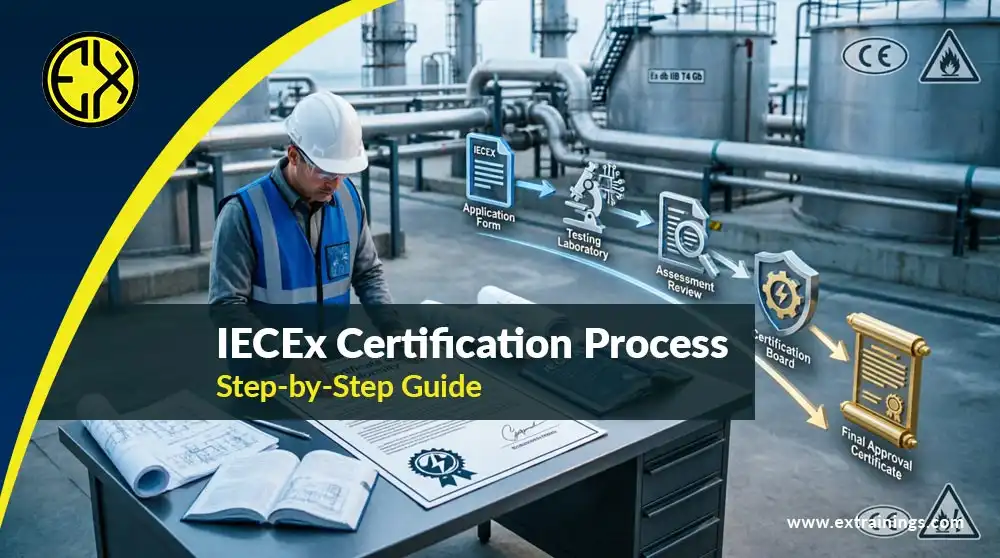
The IECEx certification process checks if your equipment is safe for use in hazardous areas. It follows six clear steps — from application to certificate approval. The process is managed by accredited bodies and follows IEC 60079 standards.
If you make equipment for explosive environments, you need IECEx Certification. This guide walks you through every step. It is written for manufacturers, engineers, and certification teams who want a clear, practical overview.
What Is the IECEx Certification Process?
The IECEx certification process is how manufacturers get an IECEx Certificate of Conformity (CoC). This certificate proves your equipment is safe for use in areas where gas, dust, or vapors can cause explosions.
The process is run by the IECEx Scheme under the International Electrotechnical Commission (IEC). It uses IEC 60079 standards. These standards cover protection methods like flameproof (Ex d), intrinsic safety (Ex i), increased safety (Ex e), and pressurized enclosures (Ex p).
Who uses this process?
- Equipment manufacturers
- OEM suppliers
- EPC contractors
- Procurement and certification teams
Why Do Companies Need IECEx Certification?
Equipment used in oil refineries, gas plants, offshore platforms, and mining sites must meet explosion protection rules. Without certification, your equipment cannot enter these sites.
It is also a business requirement. Major operators like ADNOC, Saudi Aramco, and QatarEnergy require valid IECEx certificates. Procurement teams will reject uncertified equipment during supplier checks.
IECEx certification also gives you access to 40+ countries. You do not need separate approvals in each country. That saves time and cost.
Step-by-Step IECEx Certification Process
Step 1: Find the Right IECEx Standards for Your Product
Start by confirming which IEC 60079 standards apply to your equipment. This depends on:
- Your equipment type
- The protection method it uses
- The Equipment Protection Level (EPL) needed
- The Gas Group and Temperature Class
Example: A flameproof motor for Zone 1 must meet IEC 60079-0 and IEC 60079-1. If the EPL is Gb, it needs a high level of protection.
Getting this right early avoids delays and rework during testing.
Step 2: Choose an IECEx Certification Body (ExCB)
An ExCB is an accredited body that issues IECEx certificates. Only bodies listed on the official IECEx website can issue valid certificates.
When picking an ExCB, check:
- Does it cover your product type?
- Does it have experience with your protection method?
- What are its typical turnaround times?
Once you choose, submit your application. The ExCB will review your scope, assign a testing lab, and manage the quality audit process.
Step 3: Product Testing by an ExTL
An IECEx Testing Laboratory (ExTL) tests your product against IEC 60079 standards. Testing is required for all equipment seeking IECEx certification.
The ExTL checks:
- Equipment design
- Temperature performance
- Enclosure integrity
- Safety under fault conditions
Send complete technical documents with your product. Missing drawings or incomplete specifications will delay testing. Prepare everything before your product goes to the lab.
Step 4: The ExTL Prepares the Test Report (ExTR)
After testing, the ExTL writes an IECEx Test Report (ExTR). This report covers:
- Every test performed
- Standards applied
- Test results
- Any special conditions or limits
The ExCB uses this report to assess your product. If the report finds issues, you must fix them before moving forward.
Ask your team to check the draft ExTR before it is finalized. Errors in Gas Group references, equipment markings, or Temperature Class data can cause problems later.
Step 5: Quality Assessment Report (QAR)
The QAR is an audit of your factory and production system. An ExCB auditor visits your site and checks:
- Production process documentation
- Inspection procedures
- Material tracking and controls
- Traceability records
The goal is to confirm that your factory can consistently build equipment that matches the certified design.
If you already have ISO 9001 certification, some documents may already be ready. But the QAR focuses specifically on explosion protection controls.
The QAR must be approved before your certificate is issued.
Step 6: IECEx Certificate of Conformity Is Issued
Once the ExCB approves both the ExTR and QAR, your certificate is issued. It is registered in the IECEx Online Certification System (OCS) and can be verified at iecex-certs.com.
Your certificate shows:
- Equipment description
- Applicable standards
- Protection method and EPL
- Gas Group and Temperature Class
- Any special conditions of use
Keep your certificate up to date. Design changes or standard updates may require a certificate revision.
IECEx Certification Documents Checklist
Missing documents are the top reason for delays. Prepare these before you apply:
- ✅ Technical Documentation Package — Drawings, circuit diagrams, materials list, and BOM
- ✅ IECEx Application Form — Submitted to your chosen ExCB
- ✅ Risk Assessment — Required under IEC 60079-0
- ✅ IEC 60079 Compliance Matrix — Shows how your product meets each standard clause
- ✅ Test Samples — Physical units submitted to the ExTL
- ✅ Quality System Documents — Procedures and inspection records for the QAR
- ✅ Existing National Certificates — ATEX or similar certificates may reduce testing scope
- ✅ Ex Marking Schedule — Confirms your correct Ex marking string
- ✅ Special Conditions Documentation — Required if the ExTR identifies use limitations
ExCB vs ExTL: What Is the Difference?
Both bodies play key roles. Here is how they differ:
| Aspect | ExCB (Certification Body) | ExTL (Testing Laboratory) |
| Main Role | Issues the Certificate of Conformity | Tests the product against IEC 60079 |
| Accreditation | Accredited by IECEx to certify | Accredited by IECEx to test |
| Key Output | IECEx Certificate of Conformity (CoC) | IECEx Test Report (ExTR) |
| QAR Role | Conducts and approves the QAR | No role in QAR |
| Listed On | IECEx website — ExCB Directory | IECEx website — ExTL Directory |
| Your Contact For | Application and certification | Testing scope and sample submission |
| Can They Overlap? | Yes — some bodies hold both roles | Yes — some ExTLs work with multiple ExCBs |
Always confirm that your ExCB and ExTL both hold current IECEx accreditation. Check their scope — not all labs cover every protection method.
How Long Does IECEx Certification Take?
Most IECEx certifications take 3 to 12 months.
Simple products with complete documents usually finish in 3–5 months. Complex products with multiple protection methods or design issues can take 8–12 months.
Key factors that affect timing:
- How complete your documents are at submission
- Lab availability and test scheduling
- Number of test failures or redesigns
- QAR audit scheduling
- ExCB review queue
The best way to speed up the process is to prepare well before you apply.
Common Reasons IECEx Certification Gets Delayed
Delays cost time and money. Here are the most common causes:
- Incomplete documents — Missing drawings or undefined materials stop the ExTL from testing
- Wrong standard selected — Using the wrong IEC 60079 standard leads to failed tests
- Product does not match drawings — Differences between the sample and submitted documents cause issues
- Weak quality system — Poor production records fail the QAR
- Late sample delivery — Sending your test product late pushes you to the back of the queue
- Design changes mid-process — Changes after testing starts require re-testing
- Errors in the ExTR — Mistakes in the test report must be fixed before the ExCB can accept it
- Slow communication — Delays in responding to ExCB or ExTL queries slow everything down
Fix these issues before you submit. Do not wait until they show up during the process.
How to Prepare for IECEx Certification
Use this checklist before you submit your application:
- ✅ Confirm all IEC 60079 standards that apply to your product
- ✅ Complete your full technical documentation package
- ✅ Check your product against all relevant standard clauses
- ✅ Document any special conditions that may apply
- ✅ Update quality procedures for explosion protection manufacturing
- ✅ Make sure your factory is ready for a QAR audit
- ✅ Confirm your ExCB and ExTL have the right accreditation scope
- ✅ Send test samples that exactly match your submitted drawings
- ✅ Check your Ex marking schedule for accuracy
- ✅ Assign one person internally to manage all ExCB and ExTL communications
Need help understanding protection zones before you apply? Review hazardous area protection concepts or sign your team up for IECEx certification training.
IECEx Product Certification vs IECEx Personnel Certification
These are two different processes. Both matter — but they serve different purposes.
| Aspect | Product Certification | Personnel Certification (CoPC) |
| Purpose | Certifies equipment meets IEC 60079 standards | Certifies a person is competent for hazardous area work |
| Who It Applies To | Manufacturers and OEM companies | Engineers, technicians, inspectors |
| Key Output | IECEx Certificate of Conformity (CoC) | IECEx Certificate of Personnel Competence (CoPC) |
| Steps | Apply → Test → ExTR → QAR → Certificate | Train → Assess → Exam → CoPC |
| Validity | Maintained via annual surveillance | Usually 5 years, renewed by reassessment |
| Check Status | iecex-certs.com | iecex-certs.com |
| Standard Used | IEC 60079 series | ISO/IEC 17024 |
Certified equipment with untrained staff creates compliance gaps. Trained staff working with uncertified equipment creates safety risks. You need both.
If your staff are pursuing IECEx CoPC certification, that follows a separate route through an IECEx Recognized Training Provider. You can check anyone’s certificate status through IECEx certificate verification.
For pricing across both product and personnel routes, see the IECEx certification cost guide for UAE, Saudi Arabia, Qatar, and India.
Start Your IECEx Certification Right
Preparation is the biggest factor in a smooth certification. Manufacturers who get their documents, product design, and quality systems ready before applying finish faster and spend less.
The steps are clear. The requirements are set. What makes the difference is how ready you are when you start.
If you are starting out or reviewing a stalled application, use this guide to build your preparation plan.
Frequently Asked Questions
What is the IECEx certification process?
The IECEx certification process is a six-step approval system for hazardous area equipment. Steps include: confirm applicable standards, choose an ExCB, complete product testing at an ExTL, get the ExTR, pass the QAR, and receive your Certificate of Conformity. The certificate is then listed on the IECEx OCS.
How do I apply for IECEx certification?
Choose an accredited ExCB from the IECEx website. Prepare your technical documents. Submit your application with your product scope. The ExCB will guide you through testing, the QAR, and final certificate approval.
What documents are required for IECEx certification?
You need technical drawings, a compliance matrix, an application form, risk assessments, test samples, quality system documents, and an Ex marking schedule. Existing certificates like ATEX may reduce the testing scope.
What is the role of an ExCB?
An ExCB is an IECEx-accredited certification body. It reviews your application, manages the QAR audit, evaluates the ExTR, and issues your Certificate of Conformity. It is your main point of contact throughout the process.
What is the role of an ExTL?
An ExTL is an IECEx-accredited testing lab. It tests your product against IEC 60079 standards and produces the ExTR (Test Report). This report is used by the ExCB to assess compliance.
How long does IECEx certification take?
Most certifications take between 3 and 12 months. Simple products with complete documents finish in 3–5 months. Complex products or those with test failures can take up to 12 months. Good preparation before submission is the best way to reduce the timeline.
What happens after IECEx certificate approval?
Your certificate is published on the IECEx OCS at iecex-certs.com. You must maintain it through annual surveillance. If you change the product design or manufacturing process, you may need to update the certificate.