IECEx CoC vs CoPC: What Is the Difference Between Equipment and Personnel Certification?
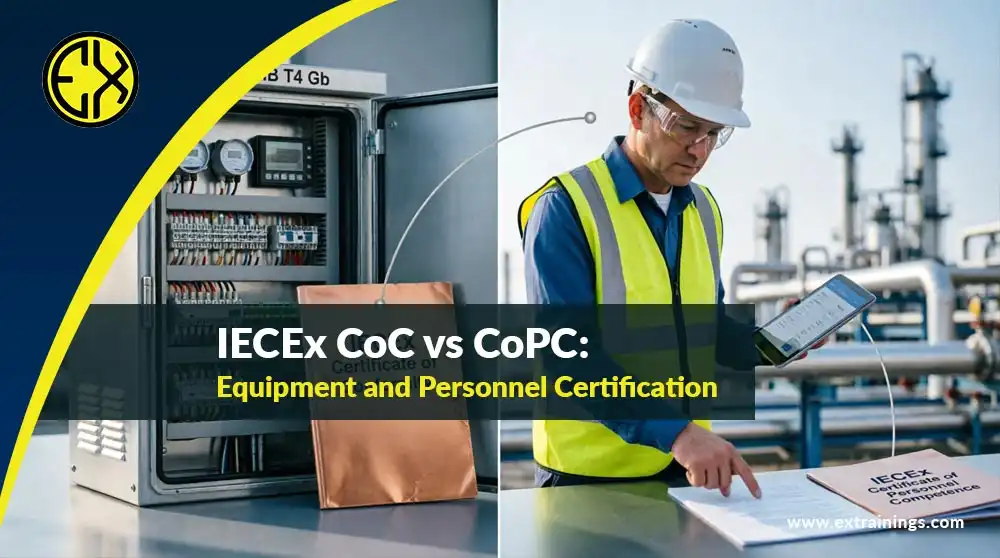
The IECEx Scheme has two types of certificates. The Certificate of Conformity (CoC) is for equipment. The Certificate of Personnel Competence (CoPC) is for people. They are not the same. Many engineers and companies confuse them. That confusion can cause compliance problems. This article explains both clearly and helps you decide which one you need.
What Is IECEx CoC?
IECEx CoC is an equipment certificate. It confirms that a product meets IEC 60079 standards. It is for use in areas with explosive gases or dust. Manufacturers apply for it. An accredited Certification Body (ExCB) issues it after product testing.
The IECEx CoC is part of the IECEx Certification equipment scheme. It covers Ex products like motors, sensors, junction boxes, and lights used in hazardous locations.
Key facts about IECEx CoC:
- Issued to manufacturers and suppliers
- Covers a specific product or product range
- Requires testing by an IECEx Test Laboratory (ExTL)
- Includes a Quality Assessment Report (QAR) of the manufacturer’s site
- Based on IEC 60079 series standards
- Accepted in 40+ countries under the IECEx Scheme
- Listed in the IECEx On-Line Certification System (OCS)
What Is IECEx CoPC?
IECEx CoPC is a personnel certificate. It confirms that a person has the knowledge and skill to work safely with Ex equipment. It is issued to individuals — not products. An accredited ExCB issues it after training, exams, and a practical assessment.
The IECEx CoPC certification follows ISO/IEC 17024. This is the global standard for certifying people. It covers competency units for design, installation, inspection, and maintenance of Ex equipment.
Key facts about IECEx CoPC:
- Issued to individual professionals
- Covers specific competency units (e.g., Ex 001 to Ex 010)
- Requires training, a written exam, and a practical test
- Valid for five years, then must be renewed
- Based on IEC 60079-14, IEC 60079-17, and related standards
- Searchable in the IECEx OCS by name or certificate number
IECEx CoC vs CoPC: Key Differences
| Factor | IECEx CoC | IECEx CoPC |
| What it certifies | Equipment / product | Individual person |
| Applicant | Manufacturer or supplier | Engineer, technician, or inspector |
| Purpose | Confirms product meets IEC 60079 | Confirms person is competent for Ex work |
| Issued by | Accredited ExCB | Accredited ExCB |
| Assessment method | Product testing + QAR review | Written exam + practical assessment |
| Scope | Product-specific | Competency unit-specific |
| Validity | Ongoing (with surveillance) | 5 years (renewable) |
| Who uses it | Procurement and project teams | HR, site managers, contractors |
| Verification | IECEx OCS | IECEx OCS |
Who Needs an IECEx Certificate of Conformity?
Manufacturers and suppliers need the IECEx CoC. They make equipment for use in explosive atmospheres. Procurement teams, project engineers, and EPC contractors also work with CoC records. They must check that equipment is certified before it enters a hazardous site.
If you buy or approve Ex equipment, you don’t apply for the CoC. The manufacturer does. But you must confirm it exists and is current before the equipment goes on site.
Who works with CoC documentation:
- Equipment manufacturers — to certify products for IECEx markets
- OEM companies — to validate Ex-rated components in assemblies
- Procurement teams — to confirm equipment is certified before delivery
- Project engineers — to check zone and EPL requirements are met
- Certification managers — to keep compliance records for audits
Use IECEx certificate verification to check that any CoC you receive is active and correct.
Who Needs IECEx CoPC?
IECEx CoPC is for professionals who work with Ex equipment on site. This includes electrical engineers, instrument technicians, maintenance engineers, and inspection staff. It proves that a person is competent to do a specific Ex-related job in a hazardous area.
Major operators like ADNOC, Saudi Aramco, and QatarEnergy require IECEx competency from contractors and site personnel. On oil and gas, petrochemical, and LNG projects, CoPC is now a standard requirement.
Roles that often require IECEx CoPC:
- Electrical and Instrument Engineers — zone classification and equipment design
- Installation Technicians — fitting Ex equipment per IEC 60079-14
- Maintenance Engineers — servicing Ex systems per IEC 60079-19
- Inspection Engineers — conducting inspections per IEC 60079-17
- HSE Managers — auditing hazardous area compliance
- EPC Contractors — managing Ex projects with certified teams
If your role is listed above, IECEx certification training is your first step toward CoPC assessment.
What Does IECEx CoC Certify?
IECEx CoC certifies a product. It confirms the equipment was tested and assessed by an ExCB and ExTL. It shows the product meets IEC 60079 explosion protection standards for its protection type and zone.
The CoC does not certify the person using the equipment. It only covers the product.
What a CoC confirms:
- The protection type (e.g., Ex d, Ex e, Ex i, Ex p, Ex n)
- The Equipment Protection Level (Ga, Gb, Gc for gas; Da, Db, Dc for dust)
- The zone suitability of the product
- The IEC 60079 standards used in testing
- The manufacturing quality system checked through the QAR
- The ExCB and ExTL that issued and tested the certificate
What Does IECEx CoPC Demonstrate?
IECEx CoPC shows that a person is competent to do specific hazardous area work. It is not an equipment certificate. It proves the individual can safely work with Ex equipment in line with IEC 60079 standards.
Each competency unit on the CoPC covers a different area of ability:
| Unit | Competency Demonstrated |
| Ex 001 | Explosion protection fundamentals |
| Ex 002 | Installation of Ex equipment per IEC 60079-14 |
| Ex 003 | Design verification and documentation review |
| Ex 004 | Area classification per IEC 60079-10 |
| Ex 005 | Flameproof enclosures “d” |
| Ex 006 | Increased safety “e” — motors and rotating machines |
| Ex 007 | Intrinsic safety “i” — instruments and control |
| Ex 008 | Pressurization and continuous dilution |
| Ex 009 | Dust ignition protection |
| Ex 010 | Optical radiation ignition protection |
Each unit is specific. A CoPC with Ex 002 does not qualify someone for Ex 008 work. Always match the unit to the job role.
IECEx CoC vs CoPC Certification Process
| Process Step | IECEx CoC (Equipment) | IECEx CoPC (Personnel) |
| Applicant | Manufacturer | Individual professional |
| Step 1 | Apply to an ExCB | Choose competency units and enroll in accredited training |
| Step 2 | Product tested by an ExTL | Complete theory training for selected units |
| Step 3 | QAR review of manufacturing facility | Pass a written exam |
| Step 4 | ExCB issues Certificate of Conformity | Complete a practical assessment with an ExCB |
| Step 5 | Certificate listed in IECEx OCS | CoPC issued and listed in IECEx OCS |
| Step 6 | Ongoing surveillance audits | Renewal every 5 years |
Both schemes go through accredited ExCBs. Learn more about the full IECEx certification process before you start. A certificate is only valid if it appears in the IECEx OCS.
Can IECEx CoC and CoPC Replace Each Other?
No. CoC and CoPC are completely different. CoC is for products. CoPC is for people. One cannot replace the other. On many projects, you need both.
Certified equipment still needs a certified person to install and maintain it. Without that, you have a compliance gap.
Key points:
- A CoC does not allow anyone to work in a hazardous area
- A CoPC does not make non-certified equipment compliant
- Most major operators require both — certified equipment and certified personnel
- Procurement verifies CoC. HR and site managers verify CoPC
- Neither certificate can cover the role of the other
IECEx CoC vs CoPC: Which One Do You Need?
Use this checklist to find the right certification for your situation.
You need IECEx CoC if you:
- Make or supply Ex equipment
- Sell products into IECEx member countries
- Need to show your product meets IEC 60079
- Are an OEM using Ex-rated components
- Buy equipment and need to confirm it is certified
You need IECEx CoPC if you:
- Install, inspect, or maintain Ex equipment on site
- Design hazardous area electrical systems
- Work in Zone 0, Zone 1, or Zone 2 areas
- Are required by ADNOC, Saudi Aramco, or QatarEnergy to prove competence
- Manage Ex projects as an EPC contractor
You may need both if you:
- Make Ex equipment and also have engineers who install it
- Run projects where your team designs and installs Ex systems
Common Misunderstandings About IECEx CoC and CoPC
These are the most common mistakes people make:
“A CoC means the equipment is safe anywhere.”
Not true. A CoC confirms the product was tested for a specific protection type and EPL. It must still be installed correctly, in the right zone, by a competent person.
“My training certificate is the same as a CoPC.”
It is not. A training certificate shows you attended a course. A CoPC is issued only after you pass a written exam and a practical test with an accredited ExCB. Only the CoPC appears in the IECEx OCS.
“CoPC is just for electricians.”
Not true. CoPC covers many roles — design engineers, safety officers, instrumentation engineers, and area classification specialists. Units are role-based, not trade-based.
“If the equipment has a CoC, our people don’t need CoPC.”
This is wrong. Equipment certification and personnel certification are separate requirements. Both are needed on most major hazardous area projects.
“CoC and CoPC follow the same process.”
They do not. The issuing body may be the same ExCB. But the process is different. CoC needs product testing and a QAR. CoPC needs training, exams, and a practical assessment.
IECEx CoC vs CoPC Quick Decision Guide
| Your Situation | Certification Required |
| You make Ex lighting fixtures | IECEx CoC |
| You install Ex equipment on an oil platform | IECEx CoPC |
| You supply Ex motors to a petrochemical plant | IECEx CoC |
| You inspect Ex installations in Zone 1 | IECEx CoPC |
| You design an Ex-rated control panel | CoC (product) + CoPC (designer) |
| You maintain Ex equipment for Saudi Aramco | IECEx CoPC |
| You need to verify a contractor’s competence | Check their CoPC in the IECEx OCS |
| You need to confirm equipment is certified | Check the CoC in the IECEx OCS |
Frequently Asked Questions
What is the difference between IECEx CoC and CoPC?
CoC is for equipment. CoPC is for people. CoC shows a product is safe for hazardous areas. CoPC shows a person is trained and tested to work in those areas. They are not the same thing.
Is IECEx CoC for equipment only?
Yes. CoC is only for products. Manufacturers apply for it. It has nothing to do with whether a person is qualified or not.
Is IECEx CoPC for people only?
Yes. CoPC is only for individuals. It shows that a specific person is competent to do specific Ex work. It does not certify any product or site.
Who needs IECEx CoPC?
Anyone who works with Ex equipment in hazardous areas needs to consider CoPC. This includes electrical engineers, instrument technicians, inspection staff, and maintenance engineers. It is common in oil and gas, petrochemicals, and mining.
Who needs an IECEx Certificate of Conformity?
Manufacturers and suppliers who make Ex equipment need to get a CoC. Procurement teams and project engineers must check CoC records before equipment goes on site.
Can a CoPC replace a CoC?
No. A CoPC proves a person is competent. It does not certify the equipment they use. Both may be required at the same time on the same project.
How do I verify an IECEx CoC or CoPC?
Go to the IECEx On-Line Certification System (OCS) at iecex-certs.com. Search by certificate number or name. It is free. Results show if the certificate is Current, Suspended, or Cancelled. For a step-by-step guide, visit IECEx certificate verification.