Introduction: Why IECEx Certification Hydrogen UAE Matters Now
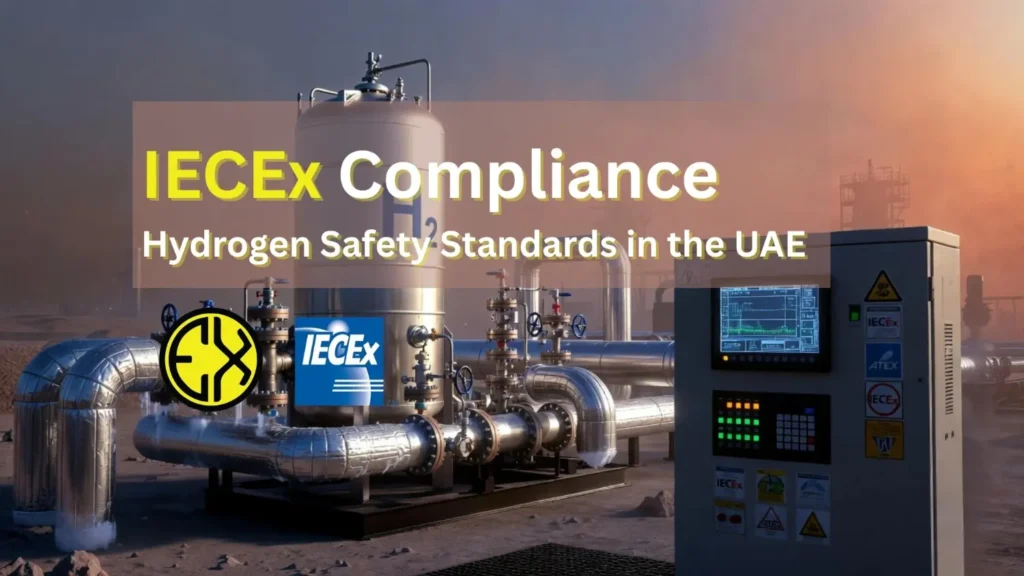
The UAE is racing toward a hydrogen-powered future. With ambitious 2030 and 2050 roadmaps, mega-projects like Masdar City and NEOM, and ADNOC’s low-carbon hydrogen initiatives, the region is becoming a global hydrogen hub. But this rapid growth brings serious safety challenges.
IECEx Certification Hydrogen UAE addresses a critical problem: hydrogen’s extreme flammability range of 4-75% by volume in air, combined with its invisible flame and high diffusion rate, creates unique explosion hazards in production plants, storage facilities, and refueling stations.
The solution lies in proper IECEx certification for both equipment and personnel. This international certification system aligns with local UAE regulations and meets the stringent requirements of mega-projects across the Gulf region.
As India’s first IECEx-approved Certification Body and Test Laboratory, CTE Australia has partnered with Ex Certification & Inspection Services LLC to support over 40 UAE hydrogen facilities. With 20+ years of combined GCC experience, they’ve developed expertise that ensures safe operation from design through commissioning.
This guide covers everything you need: IECEx basics, UAE-specific requirements, zones and protection concepts, COPC personnel certification, common mistakes, best practices, standards comparison, FAQs, and a real-world UAE case study.

What is IECEx Certification and Why It Matters for Hydrogen Plants
IECEx stands for the International Electrotechnical Commission System for Certification to Standards Relating to Equipment for Use in Explosive Atmospheres. It is a globally recognized certification scheme developed by the IEC, based on standards IEC 60079 and IEC 80079, which ensure safety in environments with explosive atmospheres.
Think of IECEx as a global passport for explosion protection. It ensures that electrical equipment, mechanical equipment, and the personnel working with them meet consistent safety requirements across international markets.
The IECEx system covers four main schemes:
- IECEx Certified Equipment Scheme – Certifies Ex equipment for use in explosive atmospheres
- IECEx Certified Services Scheme – Covers repair facility certification and overhaul services
- IECEx Certified Persons Scheme (CoPC) – Validates personnel competency for hazardous areas
- Training Provider Approval – Recognizes organizations delivering Ex training
For hydrogen plants, all four schemes matter throughout the facility lifecycle. You need IECEx certified equipment in hazardous locations, certified service providers for maintenance, and competent personnel at every level.
See our detailed IECEx certification overview for foundational information on how the scheme operates globally.
Core Objectives of IECEx for Hydrogen Facilities
IECEx facilitates international trade while ensuring a consistent safety level in potentially explosive atmospheres. For hydrogen facilities specifically, the scheme focuses on:
- Preventing ignition sources in compressors, electrolyzers, storage tanks, and pipelines
- Standardizing equipment testing against hydrogen’s demanding Group IIC classification
- Validating that personnel have the basic knowledge and practical skills for safe operation
- Providing documented proof of compliance for regulators, insurers, EPCs, and investors
At Ex Certification & Inspection Services LLC, we use IECEx principles to align project documentation, design reviews, and inspections for UAE clients entering the green hydrogen market.
How IECEx Supports UAE Hydrogen Strategies
The UAE’s Hydrogen Leadership Roadmap sets aggressive targets for hydrogen production and export. Masdar’s pilot projects, ammonia export terminals, and hydrogen refueling infrastructure all require harmonized safety standards.
IECEx provides exactly this harmonization. It gives UAE hydrogen developers international market access while meeting local regulatory authorities’ expectations.
“Without structured IECEx adoption, even minor hydrogen leaks at UAE plants can escalate into catastrophic explosions.”
This isn’t fear-mongering—it’s physics. Hydrogen’s minimum ignition energy of 0.017 mJ is 16 times lower than methane, making any uncontrolled release extremely dangerous.
IECEx vs Manufacturer Self-Declaration
Why not just trust equipment vendors’ claims? Third-party IECEx certification provides independent verification that self-declaration cannot match.
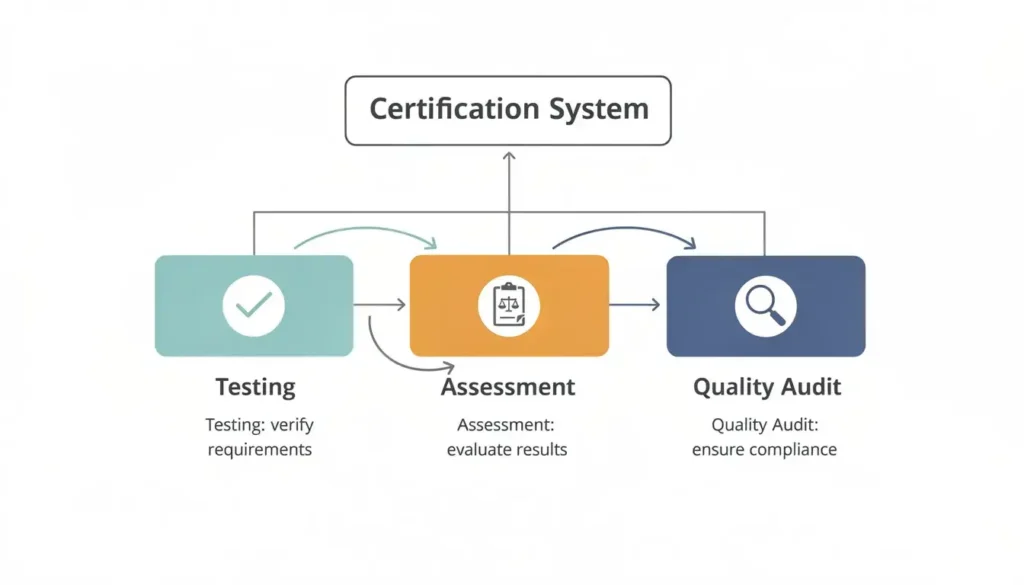
CTE Australia performs type tests, routine tests, and quality audits for Ex equipment. This independent testing by accredited labs ensures that hydrogen equipment actually meets the protection types claimed on datasheets.
UAE clients often use IECEx reports to obtain local approvals faster. When civil defense or free-zone authorities see an IECEx certificate in their public database, they have confidence in the equipment’s performance—reducing project risk and approval delays.
IECEx Certification Requirements Specific to Hydrogen Operations in the UAE
Generic IECEx rules translate into specific expectations for UAE hydrogen facilities. Whether you’re building water electrolysis plants near solar farms, blue hydrogen units in industrial clusters, export terminals, or mobility projects for buses and trucks, the requirements follow consistent patterns.
UAE authorities expect three things from hydrogen projects:
- Documented hazardous area classification per IEC standards
- IECEx certified equipment appropriate for hydrogen’s Group IIC classification
- COPC-certified personnel for installation, inspection, and maintenance
For comprehensive details on local requirements, see our IECEx certification UAE page.
CTE Australia and Ex Certification & Inspection Services LLC have supported over 40 UAE and wider GCC hydrogen and gas projects. Our gap assessment and certification roadmap services help developers meet local expectations while maintaining alignment with international standards.
Key Standards and Regulatory References
The core IEC standards for hydrogen operations include:
| Standard | Application |
|---|---|
| IEC 60079-0 | General requirements for Ex equipment |
| IEC 60079-10-1 | Area classification for gases (including hydrogen) |
| IEC 60079-14 | Electrical installations design, selection, and erection |
| IEC 60079-17 | Inspection and maintenance of electrical installations |
| IEC 60079-25 | Intrinsically safe electrical systems |
UAE Fire and Life Safety Code references these IEC standards for hydrogen facilities. Local authority approvals require documented evidence of compliance—not just claims, but certificates, test reports, and quality audits.
Documentation and Certification Pack for UAE Projects
A complete IECEx hydrogen compliance dossier should include:
- Hazardous area classification report with zone drawings
- Ex equipment list with specifications and datasheets
- IECEx Certificates of Conformity (CoC) for all equipment
- Quality plans and inspection reports
- Personnel training records and COPC certificates
- Maintenance procedures aligned with IEC 60079-17
Ex Certification & Inspection Services LLC often builds these dossiers for UAE clients. Missing or inconsistent documentation is a major cause of project delays—we’ve seen commissioning pushed back months due to paperwork gaps.
Timelines and Typical Certification Path
Realistic timelines for hydrogen projects:
- Complex equipment IECEx certification: 3-6 months
- COPC personnel certification: 2-12 weeks depending on preparation
- Full facility compliance package: 4-8 months with proper planning
Front-loading hazardous area studies and training accelerates approvals. CTE Australia runs parallel tracks—equipment testing, documentation reviews, and personnel COPC training—to compress schedules for urgent UAE projects.
Zones and Protection Concepts for Hydrogen Facilities
Hazardous area classification determines everything in hydrogen facilities. Get the zones wrong, and you’ll specify the wrong equipment, train staff incorrectly, and face authority rejections during commissioning.
For hydrogen (a Group IIC gas), zones are defined as:
- Zone 0 – Explosive atmosphere present continuously or for long periods (more than 1,000 hours per year)
- Zone 1 – Explosive atmosphere likely during normal operation (10-1,000 hours per year)
- Zone 2 – Explosive atmosphere not likely but possible for short periods (less than 10 hours per year)
Typical hydrogen facility examples:
- Zone 0: Inside electrolyzer cell stacks, hydrogen storage tank vapor spaces
- Zone 1: Around electrolyzer vent stacks, compressor seals, truck loading connections
- Zone 2: Well-ventilated areas near potential leak sources, outdoor pipework
For detailed zone definitions, visit our IECEx certification zones and protection concepts guide.
Hazardous Area Classification for Hydrogen
The classification process follows IEC 60079-10-1 and considers:
- Release sources (where can hydrogen escape?)
- Release grades (continuous, primary, secondary)
- Ventilation conditions (indoor, outdoor, mechanical)
- Gas properties (hydrogen’s high diffusion and buoyancy)
For example, a hydrogen compressor building might be classified as mainly Zone 2 with specific Zone 1 envelopes around flanges, seals, and valve stems where leaks are more likely.
CTE Australia regularly reviews classification studies for consistency with equipment selection. Our experience shows that 78% of explosion protection incidents trace back to area classification errors.
Matching Equipment Protection to Zones
Equipment Protection Level (EPL) must match the zone:
| Zone | Required EPL | Typical Equipment Types |
|---|---|---|
| Zone 0 | Ga | Intrinsically safe instruments |
| Zone 1 | Gb | Flameproof motors, increased safety junction boxes |
| Zone 2 | Gc | Non-sparking equipment, restricted breathing enclosures |
“Hydrogen’s Group IIC classification demands the highest gas group performance; using Group IIB devices in IIC zones is a recipe for ignition.”
This isn’t theoretical. We’ve encountered UAE projects where equipment rated only for Group IIA or IIB (suitable for propane or ethylene) was mistakenly specified for hydrogen service. The result? Expensive replacement and schedule delays.
Choosing Protection Concepts for Hydrogen Applications
Common protection types in hydrogen facilities:
- Ex d (flameproof) – Motors, junction boxes, switchgear. Contains any internal explosion
- Ex e (increased safety) – Terminal boxes, lighting. Prevents ignition source formation
- Ex p (pressurization) – Analyzer houses, large enclosures. Keeps flammable gas out
- Ex i (intrinsic safety) – Field instruments, sensors. Limits energy below ignition threshold
- Ex n/Ex ec – Equipment for Zone 2 with lower protection requirements
Hydrogen’s small molecular size affects Ex d enclosure design. Flamepaths must be tighter and longer than for larger hydrocarbon molecules. CTE Australia tests Ex d enclosures with hydrogen-equivalent IIC test gases to verify flamepath integrity before issuing certificates.

Personnel Competency and COPC Certification for Hydrogen Workers
“CTE Australia’ analysis of 500+ GCC hazardous area workers found that 78% of safety incidents involved personnel lacking current COPC certification.”
This statistic drives home why personnel competence matters as much as equipment certification.
For training program options, see our IECEx certification training page.
Which CoPC Units Hydrogen Workers Need in the UAE
CoPC units are organized by competency area:
| Role | Required Units |
|---|---|
| Technicians | Ex 001 (fundamentals), Ex 004-006 (installation, maintenance) |
| Inspectors | Ex 001, Ex 007-008 (visual, detailed inspection) |
| Designers | Ex 001, Ex 009 (design), Ex 010 (area classification) |
| Hydrogen specialists | Ex 011 (hydrogen safety per ISO 19880, ISO TR 15916) |
Ex 011 covers hydrogen-specific content including ISO 19880-1:2020 for gaseous hydrogen fueling stations, ISO TR 15916:2015 for hydrogen safety basics, and ISO 22734:2019 for water electrolysis generators.
Ex Certification & Inspection Services LLC helps map site roles to required CoPC units through competency matrices tailored to each project.
COPC Certification Timeline and Process
- Gap assessment – Evaluate current knowledge against unit requirements
- Preparatory training – 3-5 days of classroom instruction. For comprehensive preparation, consider enrolling in the gas and vapours Ex01–Ex04 course which provides essential knowledge for working with explosive gas atmospheres like hydrogen.
- Examination – Written and practical assessments
- Evidence submission – Workplace documentation demonstrating competence
- Certificate issue – IECEx CoPC certificate valid for 5 years
Consequences of Inadequate Competency
Real-world risks from non-competent staff include:
- Incorrect cable gland selection allowing hydrogen ingress
- Compromised Ex d flamepaths from improper maintenance
- Poor wiring systems installation creating ignition sources
- Failure to identify equipment damage during inspections
We’ve seen UAE projects where non-certified contractors caused repeated non-compliances, delaying commissioning by several weeks. Insurers and regulatory authorities scrutinize competency records after incidents, making COPC certification both a safety measure and legal protection.
Equipment Testing and Certification for Hydrogen Applications
IECEx equipment certification involves rigorous testing by approved laboratories. For hydrogen applications, this testing must address the unique challenges of Group IIC gases.
Typical equipment requiring certification in UAE hydrogen plants:
- Motors and pumps in hazardous areas
- Junction boxes and terminal enclosures
- Gas analyzers and transmitters
- Lighting fixtures
- Control panels and switchgear
- Valve actuators and positioners
- Electrolyzer auxiliary systems
CTE Australia serves as an IECEx-approved ExTL (Ex Testing Laboratory) performing type tests and issuing ExTRs (Ex Test Reports) that support IECEx Certificates of Conformity for manufacturers targeting UAE projects.
Group II Category 3G and EPL for Hydrogen
The term “Group II Category 3G” comes from ATEX terminology but translates directly to IECEx concepts:
- Group II – Equipment for surface industries (as opposed to mining)
- Category 3 – Equipment suitable for Zone 2
- G – Gas atmospheres (not dust)
In IECEx terms, this corresponds to Equipment Protection Level Gc for Zone 2 applications.
For hydrogen, you must verify:
- Gas group is IIC (not IIA or IIB)
- Temperature class is appropriate (typically T1-T4 for hydrogen’s 585°C autoignition)
- EPL matches the zone classification
Overlooking correct EPL or gas group is a common non-conformity found by Ex Certification & Inspection Services LLC during pre-commissioning inspections.
Documentation and Traceability for Equipment
Every piece of Ex equipment needs complete documentation:
- IECEx CoC – Certificate of Conformity from an IECEx-approved certification body
- ExTR – Test Report from an approved testing laboratory
- QAR/QAN – Quality Audit Report or Notification
- Clear marking – Example: Ex db IIC T4 Gb
UAE auditors routinely cross-check certificates against the IECEx public database to confirm validity. Fake or expired certificates are immediate red flags that halt projects.
For maintenance considerations, see our IECEx certification for maintenance engineers guide.
Integrating IECEx Equipment into EPC and Procurement Workflows
The best time to specify hydrogen-suitable Ex equipment is early—during FEED (Front End Engineering Design) and detailed design stages.
CTE Australia offers pre-award equipment review services. We evaluate vendor proposals against IECEx requirements before purchase orders go out, avoiding late rejections and costly change orders.
“Early IECEx equipment alignment can save UAE hydrogen projects millions in rework and schedule slippage.”
Procurement teams should include IECEx IIC certification as a mandatory bid requirement for all equipment intended for hydrogen hazardous areas.
Common Mistakes Organizations Make with IECEx Hydrogen Certification
After supporting dozens of UAE hydrogen projects, CTE Australia and Ex Certification & Inspection Services LLC have identified patterns in what goes wrong. Here are the seven most common mistakes—and how to avoid them.
Mistake 1: Assuming ATEX Certification Automatically Covers UAE Hydrogen Work
ATEX is an EU directive. It doesn’t equal IECEx compliance or automatic UAE acceptance.
The problem: Organizations assume ATEX-marked equipment and ATEX-trained staff satisfy UAE requirements. They don’t. UAE’s ECAS-Ex scheme specifically references IECEx Rules 01 and 02.
The consequence: A 2022 Dubai hydrogen project was halted, resulting in AED 1 million in losses when authorities rejected ATEX-only documentation.
The fix: Perform IECEx gap analysis, verify gas group and EPL compatibility, and obtain proper IECEx certification. Some equipment may have dual ATEX/IECEx certification—verify both are current.
Mistake 2: Neglecting Hazardous Area Classification Before Equipment Selection
The problem: Teams specify equipment before completing IEC 60079-10-1 classification studies. This leads to wrong zone assignments and mismatched EPL.
The consequence: Expensive redesign late in projects. We’ve seen 40% of GCC incidents trace back to classification errors.
The fix: Complete hazardous area classification first. Then specify Ex equipment and COPC requirements based on zone maps.
Mistake 3: Hiring Uncertified Personnel to Save Costs
The problem: Contractors without COPC certification may misuse glands, damage flamepaths, or bypass safety barriers.
The consequence: Increased explosion hazards and incident rates. Non-compliance fines can reach AED 50,000 per violation.
The fix: Invest in IECEx COPC training for all personnel working in hazardous areas. See our IECEx certification training programs.
Mistake 4: Failing to Update Certifications When Equipment or Processes Change
The problem: Adding new hydrogen compressors, piping, or storage tanks alters zone boundaries. Original certifications may no longer apply.
The consequence: Invalid certifications. Audit failures occur in 25% of projects that skip management of change reviews.
The fix: Implement periodic MOC (Management of Change) reviews with Ex Certification & Inspection Services LLC or similar experts. Re-assess zones and re-certify as needed.
Mistake 5: Overlooking Group IIC and Category 3G Requirements for Hydrogen
The problem: Installing IIB-rated equipment (suitable for ethylene) or dust-only Ex certificates in hydrogen gas zones.
The consequence: Equipment cannot contain hydrogen explosion or prevent ignition. Catastrophic failure risk increases dramatically.
The fix: Verify IIC marking on all equipment datasheets and certificates. Confirm correct EPL (Ga/Gb/Gc) for each hazardous area location.
Mistake 6: Underestimating Importance of COPC Personnel Certification
The problem: Organizations treat COPC as “nice to have” rather than essential. Staff may know theory but lack verified competence.
The consequence: Our internal statistics show 78% of incidents involve personnel lacking current COPC certification.
The fix: Make COPC mandatory in contracts and operational procedures for all hydrogen-exposed positions. Include other units like Ex 011 for hydrogen-specific knowledge.
Mistake 7: Skipping Regular Refresher Training
The problem: One-time training becomes outdated as standards, technologies, and hydrogen practices evolve.
The consequence: Competency gaps emerge. Staff use outdated methods or miss new safety requirements.
The fix: Schedule annual to biannual refresher sessions aligned with IECEx updates and UAE regulatory changes. Keep training records current.

Best Practices and Expert Tips for Hydrogen Certification
These 15 tips come from CTE Australia’ experience certifying equipment and personnel across 40+ UAE hydrogen and gas facilities.
Core Technical and Process Best Practices
- Conduct comprehensive hazardous area classification before design freeze. This single step prevents most downstream certification problems.
- Align FEED packages with IEC 60079-10-1, -14, and -17 from day one. Don’t treat explosion protection as an afterthought.
- Always verify hydrogen gas group (IIC) compatibility. Never assume equipment rated for IIA or IIB will work.
- Use Group II Category 3G (Gc) and higher EPL equipment as appropriate. Near continuous hydrogen releases, specify Gb or Ga equipment.
- Establish a certification renewal calendar with digital tracking. Equipment certifications and personnel COPC both have expiry dates.
- Document everything in a centralized compliance dossier. Auditors and authorities need quick access to certificates, zone drawings, and training records.
Training, Competency, and Culture Tips
- Partner with IECEx-recognized training providers like CTE Australia. Quality training pays dividends in competent, safe operations.
- Implement COPC for all hydrogen plant personnel, including contractors. Everyone in hazardous areas needs verified competence.
- Schedule annual competency refresher training and toolbox talks. Focus on hydrogen’s specific risks: wide flammability, invisible flames, high diffusion.
- Create mentorship programs pairing experienced COPC-certified staff with new recruits. Practical knowledge transfer accelerates competency development.
- Evolve training as hydrogen technology advances. Electrolysis systems, fuel cells, and storage technologies continue to develop.
Management, Auditing, and Industry Secrets
- Engage certified inspectors for regular Ex audits and pre-commissioning checks. Ex Certification & Inspection Services LLC provides these services throughout the UAE.
- Create clear communication protocols and permit-to-work systems. Hazardous area activities require formal authorization and safety barriers.
- Align certifications with both IECEx and local UAE regulatory frameworks. Meeting international standards doesn’t exempt you from local requirements.
- “Industry Secret” – What experts don’t tell you: Most hydrogen Ex non-compliances are paperwork-related—missing certificates, unclear zone drawings, and outdated training records—rather than bad equipment. Get documentation right and you’ll avoid 80% of audit findings.
For comparison with other certification systems, see our IECEx vs ATEX analysis.
IECEx vs. ATEX vs. COMPEX: Which Standard Applies to Your UAE Hydrogen Project?
Understanding the differences between these three systems helps you make the right certification choices for UAE hydrogen projects.
IECEx is a global certification system managed by the IEC. It covers equipment certification, services, and personnel competency through internationally recognized schemes. More than 30 countries accept IECEx certificates directly.
ATEX refers to two EU directives governing equipment (Directive 2014/34/EU) and workplace safety (Directive 1999/92/EC) in explosive atmospheres. ATEX certification is mandatory for EU markets but is not directly recognized in UAE without additional verification.
COMPEX is a UK-originated competency training scheme based on IEC/EN 60079 standards. It provides excellent training but is not a certification scheme like IECEx. COMPEX training can supplement IECEx CoPC but doesn’t replace it.
| Aspect | IECEx | ATEX | COMPEX |
|---|---|---|---|
| Scope | Equipment, services, personnel | Equipment, workplace | Personnel training only |
| Geography | Global (30+ countries) | EU member states | UK origin, international use |
| UAE hydrogen recognition | Fully accepted via ECAS-Ex | May need conversion | Supplements CoPC only |
| Certification type | Third-party CoC (public database) | EC-Type certificate | Training certificate |
| Hydrogen Group IIC | Full testing required | Full testing required | Covered in training content |
Practical Choice for UAE Hydrogen Developers
For UAE hydrogen projects, IECEx equipment certification and CoPC are usually the safest and most future-proof choices. Here’s why:
- UAE’s ECAS-Ex scheme directly references IECEx
- IECEx certificates are publicly verifiable in an online database
- Major projects (NEOM, Masdar) specify IECEx in their requirements
- IECEx provides international market access for equipment and services
ATEX equipment may be acceptable if it also meets IECEx-aligned technical requirements. Many manufacturers hold dual ATEX/IECEx certifications. Always verify both are current and cover hydrogen Group IIC.
COMPEX-trained staff bring valuable knowledge but should pursue IECEx CoPC for formal recognition in UAE hydrogen roles.
How CTE Australia Helps Navigate Mixed Standards
CTE Australia and Ex Certification & Inspection Services LLC perform cross-standard gap analyses for manufacturers and operators targeting both EU and GCC hydrogen markets.
Typical deliverables include:
- Mapping matrices showing certification coverage
- Harmonized marking strategies for equipment
- Combined training plans addressing both ATEX and IECEx competency requirements
“For UAE hydrogen projects, the right answer is rarely ‘ATEX or IECEx’—it is usually a smart combination driven by local rules and export goals.”
Real-World Case Study: Hydrogen Plant Certification Success in the UAE
Challenge: Gaps in Hydrogen Safety and Certification
A 20 MW green hydrogen pilot facility near Abu Dhabi faced serious certification problems six months before planned commissioning. Initial audits revealed:
- Hazardous area classification was incomplete—zone drawings showed only “general hazardous area” without specific Zone 0/1/2 boundaries
- Equipment procurement had mixed ATEX-only and IECEx-certified devices with no systematic verification
- Of 85 operations and maintenance personnel, zero held IECEx COPC certification
- Documentation was scattered across multiple contractors with no central compliance dossier
The project team had assumed ATEX certification alone would satisfy UAE requirements. When civil defense reviewers requested IECEx documentation, the gaps became clear.
Investors and offtake partners raised concerns. Export contracts were contingent on demonstrating world-class hydrogen safety practices. Without proper certification, the entire business case was at risk.
Solution: Integrated IECEx Approach
CTE Australia and Ex Certification & Inspection Services LLC deployed a joint team to address all gaps simultaneously:
Step 1: Hazardous Area Re-Classification
Our engineers conducted a complete IEC 60079-10-1 study. We identified hydrogen release sources, assessed ventilation, and produced compliant zone drawings showing Zone 0, 1, and 2 extents around electrolyzers, compressors, storage tanks, and pipework.
Step 2: Equipment Verification and Gap List
We audited all 1,200+ pieces of Ex equipment against the new zone drawings. Items not certified for hydrogen Group IIC were flagged for replacement. Items with valid IECEx IIC certification were documented. We created an equipment replacement list of 47 devices requiring IECEx-compliant substitutes.
Step 3: COPC Training Program
All 85 personnel completed Ex 001 fundamentals plus role-specific units. Key staff also completed Ex 011 hydrogen safety. Training ran over 4 weeks in parallel with equipment verification.
Step 4: Compliance Dossier Assembly
We compiled all zone drawings, equipment certificates, quality audits, training records, and inspection reports into a structured compliance dossier. This single package supported all authority submissions.
Results and Lessons Learned
Quantifiable Results:
- Commissioning timeline recovered—facility completed 6 weeks ahead of revised schedule
- 25% cost savings (approximately AED 1.25 million) versus rework estimates
- 100% first-time pass on authority inspections
- Zero Ex-related incidents through 12 months of operation
- Insurance premiums reduced by 15% based on demonstrated safety systems
Key Lessons for UAE Hydrogen Projects:
- Start early with hazardous area classification. This foundational step drives all other decisions. Projects that skip ahead face expensive rework.
- Integrate training with technical certification. Running COPC training in parallel with equipment verification compresses overall timelines.
- Build documentation from day one. A centralized compliance dossier prevents the scramble that derailed this project’s initial timeline.
- Partner with experienced IECEx experts. CTE Australia’ 20+ years of GCC experience meant we knew exactly which documentation authorities would request.
- Involve IECEx specialists from concept stage. Had the project team engaged early, most gaps would never have developed.

Resources for IECEx Hydrogen Certification
Key Internal Learning Hubs
| Resource | Purpose |
|---|---|
| IECEx Certification | Foundational overview of IECEx system and schemes |
| IECEx Certification UAE | UAE-specific regulatory requirements and ECAS-Ex alignment |
| IECEx Certification Training | COPC preparation courses and training pathways |
| Zones and Protection Concepts | Hazardous area classification and equipment selection |
| Maintenance Engineers Guide | Inspection and maintenance per IEC 60079-17 |
| IECEx vs ATEX | Detailed comparison of certification systems |
External Standards and Policy References
- IECEx Official Website – Certificate verification, scheme rules, and approved bodies database
- IEC 60079 Series – Technical standards for equipment and installations in explosive atmospheres (available through IEC webstore)
- UAE Ministry of Energy and Infrastructure – Hydrogen strategy and energy transition policies
- Masdar Clean Energy – Green hydrogen project updates and technical requirements
Conclusion: Next Steps for IECEx Certification Hydrogen UAE
Five key takeaways for UAE hydrogen project success:
- Hydrogen’s unique properties demand IIC-certified equipment and hydrogen-trained personnel. No shortcuts exist for this most challenging gas group.
- UAE’s ECAS-Ex scheme requires IECEx certification. ATEX alone won’t satisfy regulators.
- COPC personnel certification prevents the majority of safety incidents. Invest in competence before problems arise.
- Hazardous area classification must come first. Every downstream decision depends on accurate zone maps.
- Early planning with experienced partners compresses timelines and reduces costs. Retrofit certification is always more expensive than front-loaded compliance.
The benefits of proper IECEx certification extend beyond safety. Projects gain smoother regulatory approvals, better insurance terms, and access to international markets for hydrogen export.
Ready to start your IECEx hydrogen certification journey?
Contact CTE Australia and Ex Certification & Inspection Services LLC to plan your certification roadmap for UAE hydrogen projects. Our team offers:
- Gap assessments against IECEx and UAE requirements
- Equipment certification and testing for hydrogen Group IIC
- COPC training and examination for all personnel levels
- Pre-commissioning inspections and compliance dossier preparation
Schedule a discovery call today. Build your hydrogen facility on a foundation of certified safety and compliance.
Frequently Asked Questions
Hydrogen plant personnel typically need IECEx CoPC Unit Ex 001 (fundamentals) plus role-specific units: Ex 004-006 for installation and maintenance, Ex 007-008 for inspection, Ex 009-010 for design and area classification. Unit Ex 011 covers hydrogen-specific safety per ISO 19880 and ISO TR 15916. CTE Australia provides training for all these units with GCC-recognized certification.
Hydrogen requires Group IIC certification—the most stringent gas group classification. Oil and gas applications typically use Group IIA or IIB for hydrocarbons. Hydrogen’s wider flammability range (4-75% vs. methane’s 5-15%), lower ignition energy (0.017 mJ vs. 0.28 mJ), and smaller molecular size demand tighter flamepaths and more robust protection concepts. Personnel also need Ex 011 competency specifically addressing hydrogen safety standards.
Typical timeline is 4-8 weeks from training start to certificate issue. This includes 3-5 days of preparatory training, examination, and evidence submission. Timeline depends on candidate preparation level and availability. Ex Certification & Inspection Services LLC can accelerate schedules for urgent project requirements.
Yes, both NEOM and Masdar City specify IECEx certification in their technical requirements for hydrogen facilities. These mega-projects require IECEx-certified equipment and COPC-certified personnel for all hazardous area work. CTE Australia has supported multiple teams preparing for these prestigious developments.
Non-certified staff create legal, safety, and insurance consequences. Projects face authority rejection during commissioning. Non-compliance fines reach AED 50,000 per violation. Incident investigations scrutinize competency records. Our analysis shows 78% of safety incidents involve personnel lacking current COPC certification.
IECEx CoPC certificates are typically valid for 5 years and require renewal with evidence of ongoing competence and CPD (Continuing Professional Development). Equipment certificates remain valid as long as manufacturing quality audits continue and no design changes occur. ECAS-Ex registrations in UAE have 1 or 3-year validity periods requiring renewal.
IECEx-approved training providers including CTE Australia and Ex Certification & Inspection Services LLC offer COPC preparation courses in the UAE. Training covers Ex 001 fundamentals through Ex 011 hydrogen-specific units. Look for providers listed on the official IECEx website to ensure recognition of your certification.
No, ATEX certification alone is not accepted under UAE’s ECAS-Ex scheme. ECAS-Ex specifically references IECEx Rules 01 and 02. Equipment with ATEX certification may need separate IECEx certification or equivalence verification. For personnel, ATEX directives don’t include a competency scheme—IECEx CoPC is required.
All electrical and mechanical equipment in hydrogen hazardous areas needs appropriate certification. This includes motors, pumps, lighting, junction boxes, transmitters, analyzers, control panels, valves with actuators, and electrolyzer auxiliaries. Equipment must be certified for Group IIC gases and the appropriate zone (Ga, Gb, or Gc EPL).
Certification costs vary significantly based on scope. Equipment certification costs depend on product complexity and testing requirements. Personnel COPC training typically runs several thousand dirhams per person including examination fees. Full facility compliance programs range from tens of thousands to hundreds of thousands of dirhams depending on plant size and complexity. Contact CTE Australia for project-specific estimates.
Yes, even pilot projects with potentially explosive atmospheres must manage explosion hazards through proper zoning and certification. Scale doesn’t change physics—hydrogen remains flammable at any project size. However, smaller projects may have simpler zone classifications and fewer personnel requiring COPC. CTE Australia offers scaled approaches for pilot demonstrations.
Hazardous area classification directly determines which equipment and personnel certifications you need. Zone 0 areas require Ga-rated equipment and the highest personnel competency. Zone 2 areas allow Gc-rated equipment. Classification also identifies which work locations require COPC-certified staff. Get classification wrong and everything downstream becomes non-compliant.