
Table of Contents
IECEx Certification
IECEx Certification – Complete Global Guide for Hazardous Area Professionals
IECEx Certification is the globally recognized system for assessing and certifying the competency of professionals working in explosive atmospheres and hazardous areas. It establishes a standardized international benchmark for personnel involved in the design, installation, inspection, maintenance, and verification of explosion-protected equipment.
Developed under the International Electrotechnical Commission (IEC), the IECEx System ensures that competent professionals meet uniform technical and safety requirements across borders — eliminating inconsistency between national standards. For engineers, technicians, inspectors, and safety managers working in high-risk environments, IECEx certification provides trusted proof of professional competency worldwide.
Whether you work in oil and gas, petrochemicals, pharmaceuticals, mining, or industrial manufacturing in the UAE, Saudi Arabia, Qatar, India, or globally, this guide explains everything you must know about IECEx certification — including competency units, certification process, industry acceptance, costs, and regional requirements.
Begin Your Journey with a Globally Accredited IECEx Training Provider
Authentic IECEx CoPC certification demands authentic preparation. Extrainings operates under the official IECEx Recognized Training Provider (RTP) accreditation held by our strategic partner, KL Training Academy / Karandikar Laboratories—ensuring your hazardous area training meets the highest international benchmarks.
Verified Credentials You Can Trust
KL Training Academy holds official RTP designation within the International IECEx System for operations across India and the United Arab Emirates. This accreditation is granted exclusively to organizations demonstrating rigorous adherence to IECEx quality frameworks and competency delivery standards.
Validate our credentials directly:
- 📍 IECEx Official RTP Registry: Confirm KL Training Academy’s Status
- 📍 Dubai Training Facility: Unique World Business Centre, Bur Dubai—your gateway to IECEx certification in the UAE.
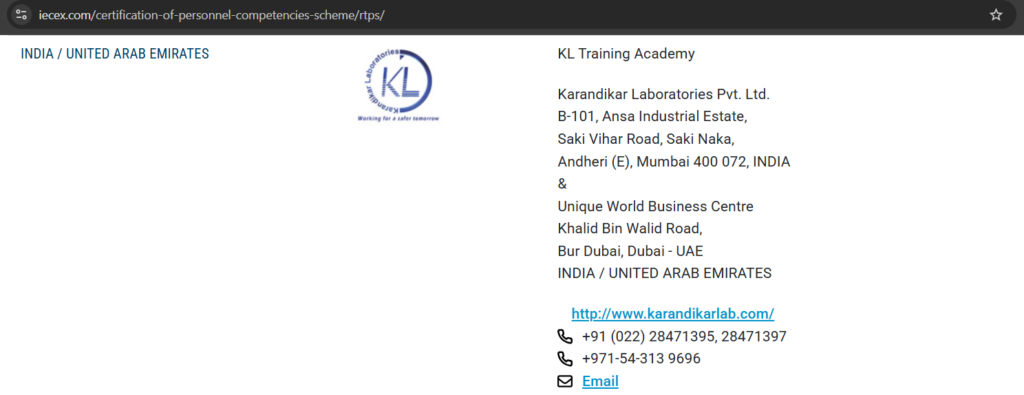
Direct Source Verification: KL Training Academy’s official listing in the IECEx RTP directory.
The Extrainings Advantage: Why Our RTP Partnership Elevates Your Success
- Assessor-Led Instruction: Learn directly from certified IECEx assessors who evaluate global candidates—giving you insider knowledge of examination expectations.
- GCC-Tailored Preparation: Our curriculum addresses region-specific regulations and industry practices across the Gulf Cooperation Council, beyond standard IECEx frameworks.
- Proven Track Record: Over 5,000+ certified professionals have launched or advanced their careers through our programs, with industry-leading pass rates.
- Curriculum Precision: Every module mirrors current IECEx competency units, eliminating gaps between training and official assessments.
- Assessment Simulation: Experience exam-format practice sessions that replicate the actual IECEx CoPC evaluation environment.
- Internationally Portable Credentials: Your IECEx Certificate of Personnel Competence opens doors across 37+ member countries, built on training that meets global standards from day one.
FREE DOWNLOAD: IEC 60079-17 Inspection Checklist
What is IECEx Certification?
The IECEx system [ Official IECEx System Website] was established to create a unified global approach to competency verification in hazardous area work. Rather than having different standards in every country, IECEx provides one internationally accepted framework that demonstrates professional capability across borders. This standardization benefits both individuals seeking career advancement and companies requiring qualified personnel for their operations.
IECEx is not a training certificate alone — it is a professional competency validation system. Certification is issued only after independent assessment of knowledge, practical ability, and work experience to ensure individuals can safely perform hazardous area work in real industrial conditions.
Why IECEx Certification is Critical
- Risk Prevention: Reduces the chance of accidents, injuries, and equipment damage in explosive atmospheres.
- Professional Credibility: Proves your knowledge in hazardous area safety, making you more employable in UAE, Saudi Arabia, Qatar, and India.
- International Recognition: Allows career mobility across 40+ countries participating in the IECEx scheme.
- Compliance Assurance: Helps organizations meet regulatory requirements and industry best practices.
The Purpose of IECEx Certification
Explosive atmospheres pose severe risks in industrial settings. When flammable substances combine with oxygen and encounter an ignition source, the results can be catastrophic. These incidents cause injuries, fatalities, environmental damage, and significant financial losses. IECEx certification addresses these risks by ensuring professionals understand how to prevent equipment from becoming ignition sources and how to maintain safety systems properly.
The certification validates that individuals comprehend explosion protection principles, can identify potential hazards, follow proper installation procedures, conduct thorough inspections, and perform maintenance without compromising safety integrity. This knowledge is critical in industries where even small mistakes can have devastating consequences.
Who Needs IECEx Certification?
Electrical and Instrumentation Engineers working in oil and gas, petrochemical, pharmaceutical, and mining operations need IECEx certification to demonstrate their competency in designing, selecting, installing, and maintaining equipment in hazardous areas. These professionals must understand zone classification, equipment protection techniques, and installation standards.
Installation Technicians require IECEx credentials to prove they can properly install explosion-protected equipment according to international standards. Their work directly impacts the safety integrity of facilities, making proper training and certification essential for minimizing risks during installation projects.
Maintenance Personnel must hold IECEx certification to perform repairs, inspections, and preventive maintenance on equipment used in explosive atmospheres. They need to understand how to maintain explosion protection features without compromising equipment safety ratings during routine servicing.
Safety Inspectors and Compliance Officers need IECEx qualifications to audit hazardous area installations, verify compliance with international standards, and ensure ongoing safety in industrial facilities. Their role involves detailed knowledge of installation requirements and documentation standards.
Project Managers and EPC Contractors benefit from IECEx certification to oversee projects involving hazardous area equipment and ensure their teams follow proper safety protocols. Understanding IECEx requirements helps them specify correct equipment and manage installation quality effectively.
Key Benefits of IECEx Certification
| Benefit | Description |
|---|---|
| Global Recognition | IECEx certification is accepted across 40+ participating countries, eliminating the need for multiple national qualifications and enabling international career mobility |
| Enhanced Safety Knowledge | Comprehensive training ensures professionals understand explosion protection principles, hazard identification, and proper safety procedures in high-risk environments |
| Career Advancement | Certified professionals gain competitive advantage in the job market, qualify for specialized roles, and command higher salaries in oil and gas, petrochemical, and mining industries |
| Industry Credibility | Demonstrates commitment to international best practices and builds trust with employers, clients, and regulatory authorities across different regions |
| Regulatory Compliance | Meets employer and regulatory requirements in key markets including UAE, Saudi Arabia, Qatar, and India where qualified personnel are mandatory for hazardous area work |
Types of IECEx Certification
The IECEx system encompasses different certification schemes, each addressing specific aspects of explosion protection. Understanding these types helps you choose the right certification path for your career goals and industry requirements.
Personnel Certification (CoPC)
The Certificate of Personnel Competence (CoPC) is the primary certification for individuals working with explosion-protected equipment. This scheme validates that professionals possess the knowledge, skills, and competence to work safely with Ex equipment in various capacities from design and installation to inspection and maintenance.
IECEx CoPC certification covers multiple competency units, each focusing on specific aspects of hazardous area work. Professionals can obtain certification in one or more units depending on their job role and responsibilities. The certification process includes theoretical training, practical assessments, and examinations to ensure comprehensive understanding.
The CoPC scheme is recognized globally and demonstrates that certified individuals can perform their duties according to international standards. Employers value this certification because it provides assurance that their workforce has been independently assessed and meets recognized competency criteria, aligning with the international quality standards set by ISO/IEC 17024 Standards.
Service Facility Certification
Service facilities that repair, overhaul, or recondition Ex equipment require certification to ensure work is performed safely and maintains the equipment’s explosion protection integrity. This scheme certifies workshops, repair centers, and maintenance facilities that work on explosion-protected equipment.
Certified service facilities must demonstrate they have appropriate quality management systems, qualified personnel, suitable tools and equipment, and proper procedures for maintaining explosion protection during repairs. This certification ensures that equipment maintains its safety ratings even after servicing.
Equipment Certification Scheme
While Extrainings specializes in personnel training rather than equipment certification, it’s important to understand that the IECEx Equipment Certification Scheme exists for manufacturers and suppliers. This scheme certifies that equipment and protective systems meet IEC 60079 standards before being placed on the market in hazardous locations.
Professionals with IECEx CoPC certification often work with certified equipment, so understanding the equipment certification process helps them verify proper specifications and compliance during installation and maintenance activities.
Ready to Get Your IECEx Certification?
How to Get IECEx Certification
Obtaining IECEx certification involves several steps that ensure you gain both theoretical knowledge and practical competence. The process is designed to verify that you can apply your learning in real-world hazardous area situations.
Step 1: Choose Your Competency Units
Begin by identifying which IECEx competency units align with your job role and career objectives. Different units cover different aspects of hazardous area work, from basic awareness to specialized technical competencies. Your employer may specify required units, or you can select based on your responsibilities.
Common starting points include foundational units that cover core concepts, followed by specialized units for installation, inspection, or maintenance. Some professionals pursue multiple units to broaden their qualifications and increase their value to employers.
Step 2: Enroll in Accredited Training
Register with an IECEx Recognized Training Provider (RTP) that offers courses for your chosen competency units. Quality training programs combine classroom instruction with hands-on practical exercises to ensure you understand both theory and application.
Training duration varies by competency unit but typically ranges from three to five days per unit. Courses cover relevant IEC standards, protection techniques, zone classification, installation requirements, inspection procedures, and maintenance practices specific to each unit.
Step 3: Complete Practical Assessments
Most IECEx competency units require practical assessments where you demonstrate your ability to apply knowledge in realistic scenarios. These assessments evaluate your hands-on skills in areas such as equipment installation, inspection techniques, documentation review, or maintenance procedures.
Practical assessments ensure you can translate theoretical knowledge into competent performance. Assessors observe your work and verify that you follow proper procedures, use appropriate tools correctly, and maintain safety standards throughout tasks.
Step 4: Pass Written Examinations
After completing training and practical assessments, you must pass written examinations that test your understanding of explosion protection principles, standards, and procedures. Examinations include multiple-choice questions, scenario-based questions, and technical problems that assess your comprehension.
Examination questions are designed to verify that you can identify hazards, select appropriate equipment, interpret technical documentation, and make informed decisions about hazardous area installations and maintenance.
Step 5: Gain Required Experience
Some competency units require documented work experience in addition to training and examinations. This experience requirement ensures that certified professionals have applied their knowledge in actual work environments and developed practical judgment through real-world exposure.
Experience requirements vary by unit and typically involve working under supervision until you demonstrate consistent competency. Employers or supervisors verify your experience through documentation submitted as part of the certification process.
Step 6: Receive Your Certificate
Upon successfully completing all requirements, you receive your IECEx Certificate of Personnel Competence. This certificate includes details about your competency units, issue date, and certification body. The certificate is registered in the international IECEx On-Line Certification System (OCS) Verify IECEx Certificates Online, providing global, publicly verifiable proof of your credentials.
This system, managed by the IEC, ensures maximum transparency, as every certificate is public and traceable to the original issuing IECEx Certification Body (ExCB). Many employers worldwide require verification through the OCS database during recruitment or contractor qualification processes to instantly confirm the certificate’s current status (i.e., Current, Suspended, or Cancelled).
Additionally, successful candidates receive a personal IECEx identification card with a photograph, providing instant, portable proof of their certification scope and validity on-site.
Step 7: Maintain Your Certification
IECEx certification typically requires periodic renewal or refresher training to ensure your knowledge remains current with evolving standards and practices. Renewal intervals vary by competency unit and certification body but commonly occur every three to five years.
Maintaining certification involves completing refresher courses, demonstrating ongoing work experience, or retaking assessments. This requirement ensures that certified professionals stay updated with industry developments and maintain their competency throughout their careers.
IECEx Certification Requirements
Different competency units have specific requirements based on the technical knowledge and practical skills needed for each role. Understanding these requirements helps you prepare effectively for certification.
Requirements for Personnel Certification
Educational Background: Most competency units require a minimum educational qualification, typically a technical diploma or equivalent in electrical, mechanical, or instrumentation engineering. Some units accept relevant work experience in place of formal education.
Technical Knowledge: Candidates must understand basic electrical or mechanical principles depending on their chosen competency units. Foundational knowledge of equipment operation, circuit theory, or mechanical systems is essential for progressing through training.
Safety Awareness: Basic understanding of industrial safety practices and hazardous area concepts is helpful before beginning IECEx training. Some training providers offer prerequisite awareness courses to establish this foundation.
Language Proficiency: Training and examinations are typically conducted in English, so adequate language skills are necessary to understand technical content, read standards, and communicate effectively during assessments.
Work Experience: While not always mandatory for initial certification, relevant work experience in industrial environments helps candidates understand practical applications and perform better in hands-on assessments.
Requirements for Service Facility Certification
Service facilities seeking IECEx certification must meet quality management requirements, employ certified personnel, maintain appropriate tools and equipment, and follow documented procedures for maintaining explosion protection during repairs. These requirements ensure consistent quality and safety in servicing operations.
Competency Unit Specific Requirements
Ex 001 – Equipment Construction and Verification: Requires understanding of explosion protection techniques, equipment construction standards, and assessment procedures. Suitable for personnel involved in equipment selection and specification.
Ex 002 – Installation, Inspection and Maintenance: The most comprehensive unit requiring knowledge of installation standards, inspection techniques, and maintenance procedures. Essential for technicians and engineers working directly with hazardous area equipment.
Ex 003 – Design Verification and Documentation: Requires understanding of design processes, documentation requirements, and verification procedures. Appropriate for design engineers and project engineers involved in hazardous area projects.
Ex 004 – Area Classification: Focuses on hazard assessment and zone classification. Requires understanding of flammable materials, ventilation effects, and classification methodology. Important for safety engineers and plant designers.
Ex 005 to Ex 010: Specialized units covering specific protection techniques such as intrinsic safety, flameproof enclosures, increased safety, and other methods. These units require detailed technical knowledge of specific protection concepts.
IECEx Certification Cost
Understanding the costs associated with IECEx certification helps you budget appropriately and plan your professional development investment. Costs vary based on several factors including location, training provider, competency units selected, and whether you pursue multiple units simultaneously.
Training Course Fees
Training course fees represent the primary cost component for IECEx certification. Prices vary by training provider, location, and competency unit complexity. Basic awareness training typically costs less than comprehensive technical units requiring extensive hands-on practice.
In the UAE, Saudi Arabia, Qatar, and India, typical training costs range from $1,500 to $3,500 per competency unit. Multi-unit packages often provide cost savings compared to taking units separately. Training fees usually include course materials, practical exercises, and examination fees.
Examination and Assessment Fees
Most training providers include examination fees in their course prices, but some charge separately for assessments. Examination fees typically range from $200 to $500 per unit depending on the certification body and assessment complexity.
If you need to retake examinations after unsuccessful attempts, additional fees apply. Many training providers offer discounted rates for retakes, though it’s more cost-effective to prepare thoroughly and pass on your first attempt.
Certification Registration Fees
Once you complete all requirements, certification bodies charge registration fees to issue your certificate and register it in the IECEx database. These administrative fees typically range from $100 to $300 per certificate depending on the certification body.
Renewal and Refresher Costs
Maintaining your IECEx certification requires periodic renewal, which involves refresher training or reassessment. Refresher courses typically cost 40-60% of initial training fees. Budget for renewal costs every three to five years depending on your competency units.
Additional Costs to Consider
Travel and Accommodation: If training isn’t available locally, factor in travel expenses and accommodation for multi-day courses. Some employers cover these costs for employee training.
Study Materials: While basic materials are included in course fees, you might purchase additional reference materials such as IEC standards, guidebooks, or practice exams to supplement your preparation.
Lost Work Time: Consider the opportunity cost of time away from work during training. Many employers view this as an investment and provide paid leave for certification activities.
Cost-Benefit Analysis
| Investment Component | Estimated Cost (USD) | Career Return |
|---|---|---|
| Single Unit Training | $1,500 – $3,500 | Qualification for specialized roles |
| Multi-Unit Package (3 units) | $4,000 – $9,000 | Senior positions, 15-25% salary increase |
| Complete Certification (5+ units) | $7,000 – $15,000 | Expert status, leadership roles, 30-40% salary premium |
While IECEx certification requires upfront investment, the career benefits typically justify the costs. Certified professionals command higher salaries, qualify for specialized roles, and enjoy enhanced job security in competitive markets. Many professionals recover their certification investment within one to two years through salary increases and career advancement.
IECEx vs ATEX Certification
Both IECEx and ATEX address safety in explosive atmospheres, but they differ in scope, recognition, and application. Understanding these differences helps you choose the right certification for your career path and target markets.
Key Differences Between IECEx and ATEX
| Aspect | IECEx | ATEX |
|---|---|---|
| Geographic Scope | Global system recognized in 40+ countries worldwide | European Union directive, mandatory for EU markets |
| Governing Body | International Electrotechnical Commission (IEC) | European Commission and EU member states |
| Standards Basis | IEC 60079 series standards | EN 60079 series (harmonized with IEC standards) |
| Market Access | Middle East, Asia, Africa, Australia, parts of Americas | European Economic Area (EEA) countries |
| Personnel Certification | Comprehensive CoPC scheme for individual competency | No unified personnel certification, varies by country |
| Recognition in GCC | Widely accepted and preferred standard | Accepted but not preferred for new projects |
| India Acceptance | Recognized by PESO, simplifies approval process | Not directly recognized, requires additional certification |
Which Certification Do You Need?
Your certification choice depends on your target work locations and career objectives. For professionals working in the UAE, Saudi Arabia, Qatar, or India, IECEx certification provides the most relevant and widely accepted credentials. These regions have increasingly adopted IECEx as their preferred standard for both equipment and personnel competency.
If you plan to work in European Union countries, ATEX certification or recognition is mandatory. However, many multinational companies operating across both Europe and other regions prefer employees with both IECEx and ATEX knowledge to ensure flexibility in project assignments.
For maximum career flexibility, some professionals pursue both certifications. The technical knowledge overlaps significantly since both systems use similar underlying standards, making dual certification more achievable than it might initially appear.
Learn more about the detailed comparison in our comprehensive guide: IECEx vs ATEX: Which One Do You Need?
Need Exact IECEx Price by Your Job Role?
IECEx Competency Units Explained
IECEx competency units are structured learning modules that cover specific aspects of working in explosive atmospheres. Each unit focuses on particular knowledge areas and skills, allowing professionals to build expertise progressively or specialize in specific areas relevant to their roles.
| Unit Code | Unit Name | Target Audience | Description |
|---|---|---|---|
| Ex 00 | Awareness Level | Supervisors, managers, procurement personnel | Foundational understanding of explosive atmospheres including basic explosion principles, zone classification concepts, equipment protection methods, and general safety considerations. Establishes common vocabulary across teams without qualifying for hands-on work. |
| Ex 001 | Equipment Construction and Verification | Procurement specialists, quality assurance personnel, engineers | Understanding explosion-protected equipment design and construction. Covers protection concepts including flameproof enclosures, increased safety, intrinsic safety, pressurization, and encapsulation. Includes interpreting equipment markings, certificates, and technical documentation. |
| Ex 002 | Installation, Inspection and Maintenance | Electricians, technicians, engineers | Comprehensive lifecycle training covering installation per IEC 60079-14, inspection techniques per IEC 60079-17, and maintenance per IEC 60079-19. Includes cable entry techniques, earthing requirements, equipment spacing, and documentation with hands-on practical exercises. |
| Ex 003 | Design Verification and Documentation Assessment | Design engineers, project engineers, consultants | Verification of hazardous area design compliance with standards. Covers design review procedures, documentation assessment, area classification drawing verification, and equipment selection verification to identify deficiencies before construction. |
| Ex 004 | Area Classification | Safety engineers, plant designers, facilities managers | Methodology for assessing hazards and classifying areas into zones. Covers release source identification, ventilation assessment, release grade determination, zone extent calculation, and creating area classification drawings for equipment selection. |
| Ex 005 | Flameproof Enclosures “d” | Specialists working with flameproof equipment | Detailed study of flameproof construction principles, joint design, testing requirements, and maintenance procedures specific to flameproof equipment. |
| Ex 006 | Increased Safety “e” | Specialists working with increased safety equipment | In-depth coverage of increased safety principles, terminal design, winding protection, and specific requirements for motors and rotating equipment. |
| Ex 007 | Intrinsic Safety “i” | Specialists working with intrinsically safe systems | Comprehensive training on intrinsic safety principles, system design, installation practices, and verification of intrinsically safe circuits and systems. |
| Ex 008 | Pressurization and Continuous Dilution | Specialists working with pressurized equipment | Specialized knowledge of pressurized and purged equipment, system design, maintenance requirements, and safety interlocks. |
| Ex 009 | Dust Ignition Protection | Specialists working in dust environments | Focus on combustible dust hazards, dust-specific protection methods, and equipment selection for environments with combustible dust. |
| Ex 010 | Optical Radiation Ignition Protection | Specialists working with optical systems | Coverage of equipment using optical radiation in potentially explosive atmospheres, including fiber optic systems and related safety considerations. |
Global Recognition of IECEx
IECEx certification enjoys recognition across more than 40 countries worldwide, making it the most internationally accepted credential for hazardous area competency. This global reach provides certified professionals with unprecedented career mobility and opportunities.
Countries Recognizing IECEx Certification
IECEx participating countries span all major industrial regions. In the Middle East, the United Arab Emirates, Saudi Arabia, Qatar, Bahrain, Oman, and Kuwait all recognize IECEx credentials. Throughout Asia, India, China, Japan, Korea, Malaysia, Singapore, and Thailand accept IECEx certification.
Australia and New Zealand have fully adopted IECEx as their national standard for hazardous area work. In Africa, South Africa and several other nations recognize IECEx qualifications. European countries including the United Kingdom, Germany, France, and others participate in the IECEx system alongside their ATEX requirements.
The Americas show growing adoption, with Brazil, Canada, and the United States having certification bodies and testing laboratories participating in the IECEx system, though regional requirements may still apply in certain jurisdictions.
Benefits of Global Recognition
Global recognition translates into practical advantages for certified professionals. You can pursue job opportunities internationally without needing country-specific retraining or additional certifications. Multinational companies value employees who hold universally recognized credentials, simplifying their workforce development and deployment strategies.
Project assignments become more flexible when your qualifications are accepted everywhere. Whether you’re assigned to an oil field in the Middle East, a refinery in Asia, or a chemical plant in another region, your IECEx certification demonstrates competency to local authorities and project stakeholders.
The portability of IECEx credentials also facilitates career progression within international companies. As you advance into regional or global roles, your certification remains valid and relevant across all locations where your company operates.
Industry Acceptance
Beyond official government recognition, major industry players worldwide specify IECEx certification in their personnel requirements. National oil companies, international oil and gas majors, petrochemical corporations, and mining companies commonly require IECEx credentials for contractors and employees working on their facilities.
Engineering, procurement, and construction firms increasingly prefer or mandate IECEx certification for their workforce. This industry-wide acceptance ensures strong demand for certified professionals and enhances job security for those who maintain their qualifications.
Regional Requirements: UAE, Saudi Arabia, Qatar and India
Understanding regional requirements helps you navigate local regulations and employer expectations in key Middle Eastern and Asian markets where IECEx certification has become the preferred standard.
United Arab Emirates (UAE)
The UAE has emerged as a regional leader in adopting international safety standards for hazardous area work. While the country doesn’t have a single unified national scheme, major operators and regulatory authorities recognize and prefer IECEx certification for personnel working in explosive atmospheres.
Abu Dhabi National Oil Company (ADNOC) and its associated companies specify IECEx competency requirements in their project specifications and contractor qualification procedures. Their commitment to safety, outlined in the Their commitment to safety, outlined in the ADNOC Group Safety and Technical Guidelines Dubai’s oil and gas operations, free zones, and industrial facilities similarly favor IECEx credentials.
The UAE’s focus on international best practices makes IECEx certification particularly valuable for professionals seeking employment with major operators, EPC contractors, or specialized service companies operating throughout the Emirates.
Discover our UAE-specific training: IECEx Certification Training
Saudi Arabia (KSA)
Saudi Arabia’s vast oil and gas industry drives significant demand for qualified hazardous area professionals. Saudi Aramco, the world’s largest oil company, recognizes IECEx certification and incorporates it into contractor and employee competency requirements. These requirements are outlined in their extensive technical specifications and the Suppliers Safety Management System (SSMS) Saudi Aramco Engineering Requirements manual, which mandates that all employees must be demonstrably competent to perform their jobs safely.
The Saudi Standards, Metrology and Quality Organization (SASO) acknowledges international standards including IECEx for hazardous area equipment and personnel competency. Major projects in the Kingdom increasingly specify IECEx credentials as part of their qualification criteria.
Professionals working in Saudi Arabia’s petrochemical complexes, refineries, and offshore facilities find that IECEx certification opens doors to premium positions with competitive compensation packages.
Qatar
Qatar’s massive liquefied natural gas (LNG) industry and associated petrochemical operations create substantial opportunities for hazardous area professionals. Qatar Energy and major EPC contractors working on Qatari projects commonly specify IECEx competency in their personnel requirements.
The country’s focus on world-class facilities and commitment to safety standards align well with IECEx principles. Professionals with IECEx certification find strong demand for their expertise across Qatar’s energy sector and associated industries.
GCC-Wide G-Mark Initiative
The Gulf Cooperation Council Standardization Organization developed the G-Mark scheme based on IECEx principles, further solidifying IECEx importance throughout the region. This regional initiative harmonizes safety requirements across GCC member states and builds on the IECEx framework.
Understanding both IECEx and G-Mark requirements positions professionals for success throughout the GCC region. The alignment between these systems means IECEx training provides excellent preparation for regional compliance.
Compare certification schemes relevant to the region: IECEx vs CompEx Certification in UAE, Saudi Arabia, Qatar
India
India’s growing industrial sector and expanding oil and gas operations create increasing demand for hazardous area competency. The Petroleum and Explosives Safety Organization (PESO) regulates hazardous area safety in India and has established working relationships with the IECEx system.
While PESO maintains its own approval processes, IECEx certification is increasingly recognized and valued by Indian employers. Major Indian oil and gas companies including Oil and Natural Gas Corporation (ONGC), Bharat Petroleum Corporation Limited (BPCL), and Indian Oil Corporation Limited (IOCL) appreciate international certifications like IECEx.
Multinational companies operating in India prefer employees with IECEx credentials because it demonstrates competency to international standards. As India continues developing its industrial infrastructure, demand for properly qualified hazardous area professionals grows steadily.
The technical content of IECEx training aligns well with Indian standards, making certified professionals effective in local operations while maintaining international competency levels. This dual relevance makes IECEx particularly valuable in the Indian market.
Understand the relationship between different schemes: CompEx vs IECEx: Understanding the Key Differences
Training Providers and Preparation for IECEx Certification
Selecting the right training provider significantly impacts your certification success and the practical value you gain from your investment. Extrainings brings specialized expertise, regional knowledge, and proven results to your IECEx certification journey.
IECEx Recognized Training Provider
Extrainings operates as an IECEx Recognized Training Provider in partnership with accredited organizations, ensuring your training meets international standards and prepares you effectively for certification assessments. Our recognition guarantees that your certificate will be accepted globally and registered in the official IECEx database.
Recognition as an authorized training provider demonstrates our commitment to quality, adherence to IECEx requirements, and ongoing compliance with international training standards. This status provides assurance that your investment in training yields legitimate, valuable credentials.
Experienced Instructors with Industry Background
Our instructors bring decades of combined experience from oil and gas, petrochemical, mining, and manufacturing industries. They understand hazardous area work from practical perspectives, not just theoretical knowledge, allowing them to provide real-world context that makes training more relevant and memorable.
Instructors share actual case studies, discuss common challenges encountered in field work, and provide insights that go beyond standard curriculum. This practical wisdom helps you avoid mistakes, work more efficiently, and apply your knowledge effectively when you return to your workplace.
Comprehensive Course Content
Our training programs cover all required competency units with thorough attention to both theoretical foundations and practical applications. Course materials include detailed handbooks, reference guides, practice exercises, and examination preparation resources that support your learning.
We regularly update course content to reflect the latest standards revisions, industry best practices, and emerging technologies in explosion protection. This commitment to currency ensures you learn the most relevant and up-to-date information available.
Hands-On Practical Training
Understanding concepts theoretically is important, but developing hands-on competency requires practical experience with actual equipment and realistic scenarios. Our training facilities include equipment samples, cable gland practice stations, inspection tools, and other resources that allow you to develop physical skills alongside theoretical knowledge.
Practical sessions let you practice installation techniques, inspection procedures, and maintenance tasks under instructor guidance. This hands-on approach builds confidence and competency that translates directly into improved workplace performance.
High First-Time Pass Rates
Our proven teaching methods and comprehensive preparation result in excellent first-time pass rates for certification examinations. Students consistently report that our training adequately prepared them for both written exams and practical assessments, reducing the need for costly retakes.
We provide practice exams, review sessions, and targeted preparation for areas where students commonly struggle. This focused approach to examination preparation maximizes your chances of success while minimizing stress and uncertainty.
Flexible Training Schedules
Understanding that professionals have demanding work schedules, we offer flexible training options including weekday courses, weekend programs, and customized schedules for corporate groups. This flexibility allows you to pursue certification without excessive disruption to your work commitments.
For organizations training multiple employees, we provide on-site training options that bring instruction to your facility. This approach reduces travel costs, allows training on your actual equipment, and minimizes time away from operations.
Regional Expertise and Support
Operating across the UAE, Saudi Arabia, Qatar, and India gives us deep understanding of regional requirements, employer expectations, and local industry practices. We tailor training to address region-specific considerations while maintaining full compliance with international IECEx standards.
Our regional presence means we understand the job market, common employer requirements, and career pathways available to certified professionals in your area. This local knowledge helps us provide relevant career guidance alongside technical training.
Ongoing Support and Guidance
Our commitment to your success extends beyond the classroom. We provide post-training support to answer questions as you apply your learning in the workplace, guidance on certification renewal, and information about advanced training opportunities as your career progresses.
Many students return to us for additional competency units, refresher training, and specialized courses as they advance in their careers. This ongoing relationship ensures you have a trusted partner throughout your professional development journey.
Comprehensive Training Portfolio
Beyond IECEx certification, we offer complementary training programs that enhance your hazardous area expertise. Our complete portfolio allows you to build comprehensive qualifications that make you more valuable to employers.
Explore our complete range of programs: IECEx CoPC Certification Guide and CompEx Certification Training Guide
Corporate Training Solutions
Organizations seeking to train entire teams benefit from our corporate training programs designed to meet specific company requirements. We work with your safety and training departments to develop customized solutions that address your operational needs while ensuring full IECEx compliance.
Corporate programs can include pre-assessment of current competency levels, customized content emphasizing your equipment and procedures, and post-training verification to confirm learning objectives were achieved. This tailored approach maximizes training effectiveness and return on investment.
Get IECEx Certified with Extrainings
Your career in hazardous area work deserves the global recognition and professional credibility that IECEx certification provides. Whether you’re starting your journey in explosion protection or advancing your existing expertise, Extrainings offers the training, support, and regional knowledge you need to succeed.
Ready to Take the Next Step?
Contact Extrainings today to discuss your certification goals and explore how our training programs can help you achieve them. Our experienced team will guide you through competency unit selection, explain the certification process, and develop a customized training plan that fits your schedule and budget.
We understand the demands of working professionals and design our programs to provide maximum learning value with minimal disruption to your work commitments. Our proven track record of certification success, combined with deep regional expertise across the UAE, Saudi Arabia, Qatar, and India, makes us your ideal partner for IECEx certification.
Invest in Your Future Today
IECEx certification opens doors to premium positions, international opportunities, and enhanced earning potential throughout your career. The knowledge and skills you gain provide lasting value that extends far beyond passing examinations. You’ll work with greater confidence, contribute more effectively to workplace safety, and position yourself as a valued professional in competitive job markets.
Don’t let another opportunity pass while competitors advance their credentials. Take control of your professional development and join the ranks of globally certified hazardous area professionals who command respect, earn premium compensation, and enjoy rewarding careers across the world’s most dynamic industries.
Contact Extrainings now to begin your IECEx certification journey. Your future in explosive atmospheres safety starts here.
Become IECEx Certified – Start Today
Frequently Asked Questions
IECEx certification is an international credential that validates professional competency for working with electrical and mechanical equipment in explosive atmospheres. The certification is managed by the International Electrotechnical Commission and recognized globally across more than 40 countries. It demonstrates that certified individuals understand explosion protection principles, can identify hazards properly, and possess the skills to install, inspect, or maintain equipment safely in hazardous locations.
While not universally mandatory, major GCC operators like ADNOC and Saudi Aramco increasingly prioritize IECEx CoPC-certified professionals for hazardous area roles, as it demonstrates internationally recognized competency in explosive atmosphere safety. Many contractor agreements and project specifications now explicitly require IECEx certification for personnel working in Zone 0, 1, and 2 classified areas. Holding your IECEx Certificate of Personnel Competence significantly strengthens your eligibility for these high-value positions across the Gulf region.
Obtaining IECEx certification involves enrolling in training with an IECEx Recognized Training Provider, completing course instruction covering your chosen competency units, passing practical assessments that demonstrate hands-on skills, successfully completing written examinations, and gaining any required work experience. Once all requirements are met, you receive your Certificate of Personnel Competence registered in the international IECEx database. The process typically takes one to two weeks of training per competency unit plus examination time.
IECEx certification costs vary based on the number of competency units pursued and your location. Single unit training typically ranges from $1,500 to $3,500 including course fees, materials, and examinations. Multi-unit packages offer better value, with three-unit programs costing approximately $4,000 to $9,000. Complete certification covering five or more units may cost $7,000 to $15,000. These investments typically yield strong returns through salary increases, career advancement, and enhanced job security in competitive markets.
Yes, IECEx certification enjoys recognition across more than 40 participating countries worldwide including the UAE, Saudi Arabia, Qatar, India, Australia, United Kingdom, Germany, China, Japan, Brazil, Canada, and many others. This global acceptance makes IECEx the most internationally portable credential for hazardous area work. Major oil and gas companies, petrochemical operators, mining organizations, and EPC contractors worldwide accept and often require IECEx certification for personnel working on their facilities.
IECEx certificates typically remain valid for three to five years depending on the competency unit and certification body requirements. After the validity period expires, renewal requires completing refresher training, demonstrating continued work experience, or retaking assessments. This periodic renewal ensures certified professionals maintain current knowledge as standards evolve and stay competent throughout their careers. Many employers track certificate expiration dates and require timely renewal as a condition of continued employment in hazardous area roles.
IECEx is a global certification system managed by the International Electrotechnical Commission and recognized in more than 40 countries worldwide. ATEX is a European Union directive mandatory for equipment and work in explosive atmospheres within EU member states. Both systems use similar technical standards, but IECEx provides broader international recognition particularly in the Middle East, Asia, Africa, and Australia, while ATEX is required specifically for European markets. Many professionals working internationally pursue knowledge of both systems for maximum career flexibility.
Requirements vary by country, employer, and specific job role. Many countries and major operators increasingly require formal certification for personnel working directly with explosion-protected equipment. Even where not legally mandated, employers strongly prefer certified professionals because certification provides objective evidence of competency and reduces liability risks. Working without proper certification may limit your employment options, restrict your responsibilities, or disqualify you from premium positions with major operators and international companies.
Your competency unit selection depends on your job role and career objectives. Technicians and engineers working directly with equipment typically pursue Ex 002 covering installation, inspection, and maintenance. Design engineers benefit from Ex 003 focusing on design verification. Safety engineers often pursue Ex 004 for area classification expertise. Consider discussing your specific situation with training providers who can recommend appropriate units based on your responsibilities and career goals. Many professionals start with core units and add specialized units as their careers progress.
IECEx certification is gaining recognition in the United States, though it does not replace National Electrical Code compliance or approvals from US Nationally Recognized Testing Laboratories. However, US-based testing laboratories and certification bodies participate in the IECEx system, and multinational companies operating in the US increasingly value IECEx credentials for their international workforce. For work exclusively in the US, compliance with NEC requirements through appropriate US certifications remains primary, but IECEx provides valuable supplementary credentials for globally mobile professionals.
CoPC stands for Certificate of Personnel Competence, which is the IECEx credential issued to individuals who successfully complete training, assessments, and examinations for one or more competency units. The CoPC demonstrates that you possess verified competency in specific aspects of hazardous area work. Your CoPC is registered in the international IECEx database where employers worldwide can verify your credentials. The certificate includes details about which competency units you hold, when certification was issued, and when renewal is required.
Work experience requirements vary by competency unit. Some units accept candidates without prior experience, while others require documented work history in relevant roles. Even when not mandatory, relevant work experience helps you understand practical applications of training content and perform better in hands-on assessments. Many candidates pursue certification while employed in related roles, applying their learning immediately in their workplace. If you lack experience, some training providers offer guidance on gaining suitable experience or recommend starting with foundational units before advancing to experience-dependent certifications.
Maintaining IECEx certification requires periodic renewal through refresher training, continued work experience documentation, or reassessment depending on your certification body’s requirements. Renewal intervals typically range from three to five years. Some certification bodies offer online refresher options while others require in-person training. Maintaining certification ensures you stay current with standards revisions, new technologies, and evolving best practices in explosion protection. Many employers monitor certificate expiration dates and require timely renewal as a condition of continued work authorization in hazardous areas.
While some theoretical components of IECEx training may be delivered online, the certification process requires hands-on practical assessments that cannot be completed virtually. Most competency units involve demonstrating physical skills with actual equipment under assessor observation. Training providers may offer blended learning approaches combining online theory instruction with in-person practical sessions and assessments. For legitimate IECEx certification, expect to complete at least some training and all assessments in physical classroom and workshop settings where your competency can be properly evaluated.