
Table of Contents
IECEx Certification
IECEx Certification – Complete Global Guide for Hazardous Area Professionals
IECEx certification is a global system that proves the competency of people and equipment used in explosive atmospheres. Run by the International Electrotechnical Commission (IEC), it covers the design, installation, inspection, maintenance, and verification of Ex-protected equipment.
The system replaces separate national rules with one uniform standard recognized in more than 40 countries. An IECEx certificate gives engineers, technicians, inspectors, and safety managers trusted proof of competency worldwide. It supports work across oil and gas, petrochemical, pharma, mining, and manufacturing in the UAE, Saudi Arabia, Qatar, and India.
Begin Your Journey with a Globally Accredited IECEx Training Provider
Choosing the right training partner matters when you work in hazardous areas. Extrainings operates under the official IECEx Recognized Training Provider (RTP) accreditation held by our strategic partner, CTE Australia —ensuring your hazardous area training meets the highest international benchmarks.
Verified Credentials You Can Trust

Mr. Owen Strath
CTE Australia Pty Ltd (CTE, SEEG)
Unit 1, 44 Milsom Street
Coorparoo, QLD, 4151
AUSTRALIA
https://www.compliance-engineering.com.au/ M (+61) 401 568 310
 Email
Email
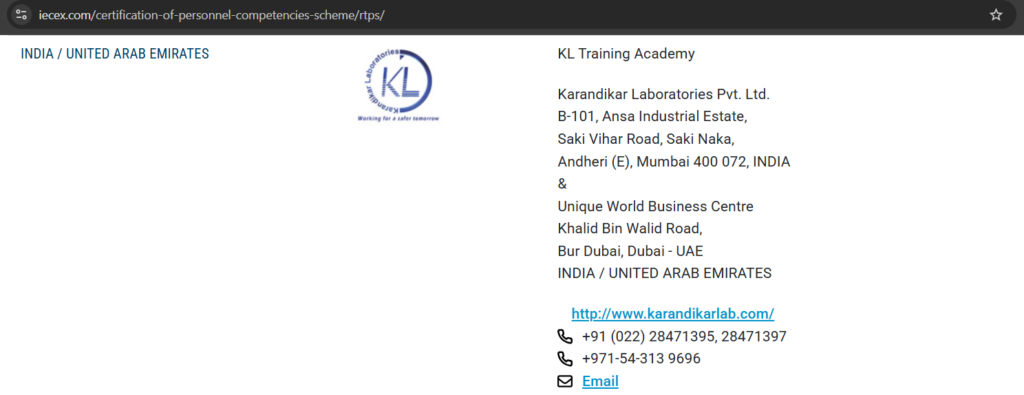
This accreditation is held by our strategic partner, KL Training Academy. Also known as Karandikar Laboratories, its RTP designation covers India and the United Arab Emirates.
IECEx grants RTP status only to bodies meeting strict quality and competency-delivery standards. You can confirm our standing through two independent sources:
Validate our credentials directly:
- 📍 IECEx Official RTP Registry: Confirm KL Training Academy’s Status
- 📍 Dubai Training Facility: Unique World Business Centre, Bur Dubai—your gateway to IECEx certification in the UAE.
The Extrainings Advantage: Why Our RTP Partnership Elevates Your Success
Choosing an authorized IECEx certification body gives you a competitive edge, not just compliance.
- Certified Assessors: Certified IECEx assessors deliver your training and evaluate candidates worldwide.
- GCC-Focused Curriculum: We tailor lessons to GCC rules, going beyond standard IECEx material.
- Proven Track Record: More than 5,000 professionals have advanced through our programs with strong pass rates.
- Current Competency Units: Every module mirrors the latest IECEx competency units in full.
- Real Exam Practice: You get exam-format sessions that match the true IECEx CoPC evaluation.
- Global Recognition: The IECEx Certificate of Personnel Competence holds value across 35+ member countries.
When you train with Extrainings and CTE Australia, you’re not just preparing for an exam—you’re investing in a certification pathway engineered for success in hazardous area industries worldwide.
FREE DOWNLOAD: IEC 60079-17 Inspection Checklist
What is IECEx Certification?
What is IECEx certification? It is an international personnel skill certification scheme built by the IEC. The scheme makes sure people who work in explosive atmospheres meet strict global safety and technical needs.

An IECEx certificate applies to people who design, select, install, inspect, keep, and check Ex equipment. This system replaces country-by-country standards with one accepted global framework. Assessors issue it only after an independent review of your knowledge, practical skill, and work history.
Why IECEx Certification is Critical
IECEx certification protects people, boosts careers, and keeps companies fully compliant.
- Risk Prevention: Certification reduces accidents, injuries, and equipment damage across explosive atmospheres.
- Professional Credibility: IECEx certification in the UAE and IECEx certification in Saudi Arabia prove your hazardous-area safety skills across Qatar and India too.
- International Recognition: Certified people gain career mobility across 40+ countries in the IECEx scheme.
- Compliance Assurance: Meeting iecex certification requirements helps companies satisfy regulators and follow industry best practices.
The Purpose of IECEx Certification
Explosive atmospheres create serious risk in many industrial settings. This danger appears when flammable substances mix with oxygen and meet an ignition source. Such incidents can cause injuries, deaths, environmental damage, and financial loss.
IECEx certification lowers this risk by teaching people two skills: how to stop equipment from becoming an ignition source, and how to keep safety systems working correctly.
Certification proves that a person understands explosion protection principles at a deep level. It also shows they can spot hazards, follow install steps, run inspections, and handle maintenance without breaking safety rules.
Who Needs IECEx Certification?
IECEx personnel certification helps anyone who works with equipment in hazardous areas. These five roles gain the most from it.
Electrical and Instrumentation Engineers
These engineers work in oil and gas, petrochemical, pharma, and mining. Certification shows their skill with electrical rotating machinery, zone classification, and safe install steps.
Installation Technicians
Their work shapes site safety in a direct way. Certification proves they can fit Ex-protected equipment to global standards during install projects.
Maintenance Personnel
Routine servicing keeps Ex equipment safe and reliable. Certification shows staff can do repairs, checks, and upkeep without harming safety features.
Safety Inspectors and Compliance Officers
An audit needs deep knowledge of install rules and record standards. Certification helps them check global rules and keep each site safe.
Project Managers and EPC Contractors
A hazardous area project needs leaders who guide teams on safe steps. Certification helps them pick the right equipment, grasp IECEx needs, and manage quality.
Key Benefits of IECEx Certification
This table shows how IECEx certification supports your safety, career, and global compliance goals.
| Benefit | Description |
|---|---|
| Global Recognition | IECEx certification wins acceptance across 40+ countries and removes the need for separate national qualifications. |
| Enhanced Safety Knowledge | Training covers explosion protection, hazard identification, and clear safety steps for high-risk sites. |
| Career Advancement | Certified people gain a job-market edge, unlock specialist roles, and earn more across oil and gas, petrochemical, and mining. |
| Industry Credibility | Certification shows your commitment to international best practice and builds trust with employers, clients, and regulators. |
| Regulatory Compliance | Meeting iecex certification requirements helps companies satisfy mandatory rules across UAE, Saudi Arabia, Qatar, and India. |
Choose IECEx certification to prove safety skill, boost your career, and meet strict regional rules with confidence.
Types of IECEx Certification
IECEx offers several certification schemes, each covering a different part of explosion protection. Knowing the types helps you pick the right path for your career goals and job needs.
Personnel Certification (CoPC)
The iecex copc certification, or Certificate of Personnel Competence, is the main credential for people who work with Ex equipment. It proves you have the knowledge and skill to work safely across design, install, inspection, and maintenance. This makes it the clearest way to show real hazardous area ability.
Each CoPC covers several competency units, and each unit targets a specific part of hazardous area work. You can get certified in one or more units, based on your job role. The iecex certification process includes theory training, practical assessment, and formal exams.
Employers value the CoPC because it proves your skill through independent, verified checks. It also aligns with ISO/IEC 17024 Standards, the benchmark for trusted personnel certification worldwide. That backing gives hiring managers real confidence in your abilities.
Service Facility Certification
Service facilities that repair, overhaul, or recondition Ex equipment need this certification. It exists to make sure repair work keeps the equipment’s explosion protection intact. The scheme certifies workshops, repair centers, and maintenance facilities that handle this specialized work.
Certified facilities must show they have proper quality management systems, qualified staff, and the right tools. They also need correct procedures for guarding against explosion during repairs. Equipment then keeps its safety rating after being serviced.
Equipment Certification Scheme
Extrainings focus on personnel training, not equipment certification. The IECEx Equipment Certification Scheme works separately for manufacturers and suppliers. It checks that equipment meets IEC 60079 standards before use in hazardous locations.
CoPC holders often work with this certified equipment on site. Knowing the equipment scheme helps them check specs and compliance during install and maintenance work.
Ready to Get Your IECEx Certification?
How to Get IECEx Certification
Getting your IECEx certification takes several clear steps that build theory and hands-on skill. Each step checks that you can apply your learning in real hazardous area work.
Step 1: Choose Your Competency Units
Start by finding which IECEx competency units fit your job role. Units range from basic awareness to specialized technical skills. Your employer may require specific units, or you can pick them based on your job duties.
Common starting units cover core concepts first, then specialized units for install, inspection, or maintenance. Some people take several units to widen their qualifications and raise their value to employers.
Step 2: Enroll in Accredited Training
Sign up with an IECEx Recognized Training Provider (RTP) offering courses for your chosen competency units. Good training blends classroom teaching with hands-on practice. This approach covers both theory and real application.
Each unit runs for a different length, usually 3–5 days. Courses cover IEC standards, protection techniques, and zone classification. You also learn install needs, inspection steps, and maintenance practices specific to each unit.
Step 3: Complete Practical Assessments
Most IECEx competency units need a practical assessment. You show that you can apply your knowledge in real work, from equipment install and inspection to documentation review and maintenance.
Assessors watch your work directly during each task. They check that you follow correct steps, use tools the right way, and keep safety standards, proving you can turn theory into skilled performance.
Step 4: Pass Written Examinations
Once training and practical assessment finish, you sit a written exam covering three question types:
- Multiple-choice questions
- Scenario-based questions
- Technical problems
The exam tests your understanding of explosion protection principles, standards, and procedures. It checks that you can spot hazards, pick correct equipment, read technical documents, and make sound decisions about hazardous area work.
Step 5: Gain Required Experience
Some units call for documented work experience on top of training and exams. This proves you have used your knowledge in real settings and built sound judgment.
Employers or supervisors confirm your experience through submitted documentation. The amount needed differs by unit, usually working under supervision until you show steady skill.
Step 6: Receive Your Certificate
After finishing all needs, you receive your IECEx Certificate of Personnel Competence. It lists your competency units, issue date, and certification body. The certificate then enters the IECEx On-Line Certification System (OCS), giving public, verifiable proof. Verify IECEx Certificates Online.
The IEC runs this system and keeps it fully open. This IECEx certificate verification tool lets anyone trace a record to the issuing IECEx Certification Body (ExCB). Employers worldwide check the OCS during hiring or contractor reviews to confirm one of three statuses: Current, Suspended, or Cancelled.
Certified people also receive a personal IECEx ID card with a photo. The card gives instant, portable proof of your certification scope and validity on-site.
Step 7: Maintain Your Certification
IECEx certification usually needs renewal or refresher training over time. This keeps your knowledge current with changing standards and practices.
Renewal timing differs by competency unit and certification body, commonly every 3 to 5 years. Staying certified means finishing refresher courses, showing ongoing work experience, or retaking assessments.
IECEx Certification Requirements
Different competency units call for different technical knowledge and practical skills. Knowing these needs helps you prepare well for certification.
Requirements for Personnel Certification
IECEx personnel certification checks that you meet clear standards before you qualify.
- Educational Background: Most units need a minimum qualification, usually a technical diploma or equal in electrical, mechanical, or instrumentation engineering. Some units accept related work experience instead of formal education.
- Technical Knowledge: People need basic electrical or mechanical principles that match their chosen units. Knowing equipment operation, circuit theory, or mechanical systems matters for moving through training.
- Safety Awareness: A basic grasp of industrial safety and hazardous area concepts helps before you start IECEx training. Some providers offer awareness courses first to build this base.
- Language Proficiency: Training and exams usually run in English. Good language skill helps you follow technical content, read standards, and communicate during assessment.
- Work Experience: First-time certification does not always need prior work history. Related industrial experience helps people understand real use and perform better in hands-on tests.
Requirements for Service Facility Certification
To qualify, a facility must have a quality management system, certified staff, the right tools, and documented explosion protection procedures for repairs. These standards keep every servicing job steady in quality and safety.
Competency Unit Specific Requirements
- Ex 001 – Equipment Construction and Verification: Needs understanding of explosion protection methods, equipment build standards, and assessment steps. This unit fits people who select and specify equipment.
- Ex 002 – Installation, Inspection and Maintenance: The most complete unit needs knowledge of install standards, inspection methods, and maintenance steps. Technicians and engineers working directly with hazardous area equipment find it essential.
- Ex 003 – Design Verification and Documentation: Understanding of design steps, documentation needs, and verification methods matters here. This unit fits design engineers and project engineers on hazardous area projects.
- Ex 004 – Area Classification: This unit covers hazard checks and zone classification, plus flammable materials, ventilation effects, and classification method. Safety engineers and plant designers benefit most from it.
- Ex 005 to Ex 010: Specialized units cover intrinsic safety, flameproof enclosures, increased safety, and other protection methods. Each one needs detailed technical knowledge of its specific protection concept.
IECEx Certification Cost
Knowing the iecex certification cost helps you budget well and plan your career investment. Your total depends on location, training provider, chosen units, and whether you take several units at once.
Training Course Fees
Training fees make up the main cost part. Price depends on the provider, location, and unit difficulty. Basic awareness training usually costs less than full technical units needing lots of hands-on practice.
Across the UAE, Saudi Arabia, Qatar, and India, training runs $1,500 to $3,500 per unit. The iecex training course fee india range often drops when you pick multi-unit packages instead of single units. Each iecex training course fee india hazardous area quote usually includes course materials, practical work, and exam fees.
Examination and Assessment Fees
Most providers fold exam fees into the course price, though some charge separately. Exam fees usually run $200 to $500 per unit, based on the certification body and assessment difficulty.
Retaking a failed exam costs extra money. Many providers offer discounted retake rates, but passing first time keeps your overall spend lower.
Certification Registration Fees
Once you finish all needs, certification bodies charge a fee to issue your certificate and add it to the IECEx database. These admin fees usually run $100 to $300 per certificate, depending on the body.
Renewal and Refresher Costs
Keeping certification active needs regular renewal through refresher training or retesting. Refresher courses usually cost 40-60% of the original training fee. Budget for renewal every 3 to 5 years, depending on your units.
Additional Costs to Consider
- Travel and Accommodation: Budget for travel and lodging when multi-day courses run outside your local area. Some employers cover this cost for their staff.
- Study Materials: Course fees give you basic materials to start learning. You may still buy extra references like IEC standards, guidebooks, or practice exams.
- Lost Work Time: Factor in the value of time lost away from work during training. Many employers view this as an investment and give paid leave.
Cost-Benefit Analysis
| Investment Component | Estimated Cost (USD) | Career Return |
|---|---|---|
| Single Unit Training | $1,500 – $3,500 | Qualification for specialized roles |
| Multi-Unit Package (3 units) | $4,000 – $9,000 | Senior positions, 15-25% salary increase |
| Complete Certification (5+ units) | $7,000 – $15,000 | Expert status, leadership roles, 30-40% salary premium |
The upfront cost of iecex certification india brings career gains that usually make it worthwhile. Certified people earn more, qualify for expert roles, and enjoy better job security. Many recover their spend within 1-2 years through pay rises and career growth.
IECEx vs ATEX Certification
Both IECEx and ATEX cover safety in explosive atmospheres, but they differ in scope, recognition, and use. Knowing the difference helps you choose the right certification for your career path and target markets.
Key Differences Between IECEx and ATEX
| Aspect | IECEx | ATEX |
|---|---|---|
| Geographic Scope | Global system recognized in 40+ countries worldwide | European Union directive, mandatory for EU markets |
| Governing Body | International Electrotechnical Commission (IEC) | European Commission and EU member states |
| Standards Basis | IEC 60079 series standards | EN 60079 series (harmonized with IEC standards) |
| Market Access | Middle East, Asia, Africa, Australia, parts of Americas | European Economic Area (EEA) countries |
| Personnel Certification | Comprehensive CoPC scheme for individual competency | No unified personnel certification, varies by country |
| Recognition in GCC | Widely accepted and preferred standard | Accepted but not preferred for new projects |
| India Acceptance | Recognized by PESO, simplifies approval process | Not directly recognized, requires additional certification |
Which Certification Do You Need?
Your choice depends on where you plan to work and your career goals. For people working in the UAE, Saudi Arabia, Qatar, or India, IECEx gives the most useful and widely accepted credential. These regions increasingly prefer IECEx for both equipment and personnel skill checks.
EU countries require ATEX certification or recognition. Many multinational companies working across Europe and other regions prefer staff who know both, for project flexibility.
Some people pursue both certifications for maximum career flexibility. The technical knowledge overlaps a lot since both systems use similar standards, making dual certification more achievable than it might at first appear.
Learn more about the detailed comparison in our comprehensive guide: IECEx vs ATEX: Which One Do You Need?
Need Exact IECEx Price by Your Job Role?
IECEx Competency Units Explained
Competency units are structured learning modules covering specific parts of hazardous area work. Each unit builds skill step by step or lets you specialize in one area for your role.
| Unit Code | Unit Name | Target Audience | Description |
|---|---|---|---|
| Ex 00 | Awareness Level | All personnel working near hazardous areas | Builds basic understanding of explosive atmospheres and their dangers. It covers explosion principles, zone classification ideas, protection methods, and general safety points. |
| Ex 001 | Equipment Construction and Verification | Equipment selectors and specifiers | Explains how manufacturers design and build Ex-equipment for safety. Protection types include flameproof enclosures, increased safety, intrinsic safety, pressurization, and encapsulation. |
| Ex 002 | Installation, Inspection and Maintenance | Technicians and field engineers | Trains the full equipment lifecycle across install, inspection, and maintenance work. Standards include IEC 60079-14, IEC 60079-17, and IEC 60079-19, plus hands-on practice. |
| Ex 003 | Design Verification and Documentation Assessment | Design and project engineers | Teaches how to check hazardous area design against recognized standards. Reviews cover design steps, documentation, classification drawings, and equipment selection before construction. |
| Ex 004 | Area Classification | Safety engineers and plant designers | Explains how to assess hazards and sort areas into zones. Tasks include finding release sources, checking ventilation, setting release grade, and drawing maps. |
| Ex 005 | Flameproof Enclosures “d” | Ex equipment specialists | Provides a deep look at flameproof build principles and joint design. It also covers testing needs and maintenance steps specific to flameproof gear. |
| Ex 006 | Increased Safety “e” | Motor and rotating equipment specialists | Delivers full coverage of increased-safety principles and terminal design. Topics include winding protection and specific needs for motors and rotating equipment. |
| Ex 007 | Intrinsic Safety “i” | Instrumentation and control engineers | Trains intrinsic safety principles, system design, and install practices in depth. You also learn how to check intrinsically safe circuits and systems. |
| Ex 008 | Pressurization and Continuous Dilution | Pressurized systems specialists | Focuses on pressurized and purged equipment and how these systems work. It covers system design, maintenance needs, and safety interlocks. |
| Ex 009 | Dust Ignition Protection | Dust environment personnel | Addresses flammable dust hazards and dust-specific protection methods. The unit also guides equipment choice for dusty environments. |
| Ex 010 | Optical Radiation Ignition Protection | Optical systems specialists | Explains equipment that uses optical radiation in explosive atmospheres. It includes fiber optic systems and related safety points. |
Global Recognition of IECEx
Countries accept IECEx certification across 40+ nations worldwide. This makes it the most widely accepted credential for hazardous area skill.
Countries Recognizing IECEx Certification
- Middle East: UAE, Saudi Arabia, Qatar, Bahrain, Oman, and Kuwait all adopt IECEx.
- Asia: India, China, Japan, Korea, Malaysia, Singapore, and Thailand support the scheme.
- Australia and New Zealand: Both countries use IECEx as their national standard.
- Africa: South Africa and several other nations accept IECEx certification.
- Europe: The UK, Germany, France, and others use IECEx alongside ATEX rules.
- Americas: Brazil, Canada, and the US host IECEx bodies, though local rules may apply.
Benefits of Global Recognition
Global acceptance gives certified people real career benefits. You can chase jobs internationally without retraining per country or gaining extra certifications. Multinational companies value staff with globally accepted credentials, which makes hiring and deployment simpler.
Project assignments get more flexible when authorities accept your certification everywhere. Your IECEx certification proves your skill to local officials and project stakeholders, wherever you work. This holds true on an oil field, a refinery, or a chemical plant.
Portable IECEx credentials help you move up within international companies. As you take on regional or global roles, your certification stays valid everywhere your company works.
Industry Acceptance
Beyond government support, major industry players name IECEx certification in their hiring needs. National oil companies, global oil and gas majors, petrochemical firms, and mining companies often require it.
Engineering, procurement, and construction (EPC) firms increasingly prefer or require IECEx certification for their workforce. This wide acceptance keeps demand high and improves job security for people who keep their certification current.
Regional Requirements: UAE, Saudi Arabia, Qatar and India
Knowing regional rules helps you handle local regulations and employer expectations across the Middle East and Asia. These markets treat IECEx as the preferred standard for hazardous area work.
United Arab Emirates (UAE)
The UAE leads the region in adopting international safety standards for hazardous area work. It has no single national scheme, yet major operators prefer IECEx certification uae for people in explosive atmospheres.
ADNOC and its associated companies name IECEx competency in project specs. This same standard shapes their contractor qualification steps across every site.
Dubai’s oil and gas operations, free zones, and industrial sites also favor IECEx credentials. The country’s focus on best practice makes certification valuable for work with major operators and EPC contractors.
Discover our UAE-specific training: IECEx Certification Training
Saudi Arabia (KSA)
Saudi Arabia’s large oil and gas industry drives strong demand for qualified hazardous area people. Aramco, the world’s largest oil company, accepts iecex certification saudi arabia. It also builds this standard into contractor and employee competency needs.
These needs appear in Aramco’s technical specs and the Suppliers Safety Management System (SSMS) manual. The manual says all staff must show they can work safely.
SASO accepts international standards, including IECEx, for hazardous area equipment and personnel skill. People working in Saudi petrochemical complexes and refineries reach premium jobs with strong pay.
Qatar
Qatar’s large LNG industry and related petrochemical work create big opportunities for hazardous area people. Qatar Energy and major EPC contractors commonly name IECEx competency in personnel needs.
The country’s focus on world-class facilities fits well with IECEx principles. Certified people meet strong demand for their skill across Qatar’s energy sector.
GCC-Wide G-Mark Initiative
The Gulf Cooperation Council built the G-Mark scheme on IECEx principles. This regional plan aligns safety rules across GCC member states and extends the IECEx framework.
Knowing both IECEx and G-Mark rules sets people up for success across the GCC. The overlap between these systems means IECEx training prepares you well for regional compliance.
Compare certification schemes relevant to the region: IECEx vs CompEx Certification in UAE, Saudi Arabia, Qatar
India
India’s growing industrial sector and expanding oil and gas work create rising demand for hazardous area skill. PESO regulates hazardous area safety in India and holds working ties with the IECEx system.
PESO runs its own approval process. Yet Indian employers value IECEx certification more and more.
Major Indian oil and gas firms value international certifications like IECEx. This group includes ONGC, BPCL, and IOCL. Multinational companies prefer staff with IECEx credentials because it proves skill to international standards.
IECEx training content fits well with Indian standards. Certified people work effectively at home while keeping their international skill level high.
Understand the relationship between different schemes: CompEx vs IECEx: Understanding the Key Differences
Training Providers and Preparation for IECEx Certification
Choosing the right training provider strongly affects your certification success and the value you gain. Extrainings brings specific expertise, regional knowledge, and proven results to your IECEx journey.
IECEx Recognized Training Provider
Extrainings operates as an IECEx Recognized Training Provider with accredited partners. This means your training meets international standards and prepares you well for certification checks.
Your certificate then gets accepted globally and added to the official IECEx database. Working with a recognized provider turns your training spend into real, valuable credentials.
Experienced Instructors with Industry Background
Our instructors bring decades of combined experience across oil and gas, petrochemical, mining, and manufacturing. They understand hazardous area work from hands-on practice, not just theory, giving lessons real-world context.
Instructors share real case studies, discuss common field challenges, and add insight beyond the coursebook. You avoid mistakes, work more efficiently, and apply your knowledge well back on the job.
Full Course Content
Training programs cover all required competency units, with close attention to theory and real use. Course materials include handbooks, reference guides, practice exercises, and exam prep resources.
Content gets updated often to match the newest standards, industry practice, and new protection technology. Fresh material keeps your learning current and directly relevant.
Hands-On Practical Training
Theory matters, yet building real skill needs practice with actual equipment and realistic scenarios. Our facilities include equipment samples, cable gland stations, inspection tools, and other hands-on resources.
Practical sessions let you try installation, inspection, and maintenance tasks under instructor guidance. Confidence and skill grow together, then show up directly in your workplace performance.
High First-Time Pass Rates
Proven teaching methods and full preparation lead to strong first-time pass rates on exams. Students say the training readied them for both written and practical assessments, cutting costly retakes.
Courses include practice exams, review sessions, and focused prep on topics students often find hard. Not only does this raise your success odds, but it also lowers your stress.
Flexible Training Schedules
Busy professionals get options that fit their work lives. Choices include weekday courses, weekend programs, and custom schedules for corporate groups.
For organizations training several staff, on-site delivery brings instruction straight to your facility. Because travel costs drop and teams train on their own equipment, time away from work shrinks.
Regional Expertise and Support
Working across the UAE, Saudi Arabia, Qatar, and India builds deep understanding of local rules and employer expectations. Training gets matched to region-specific factors while staying fully aligned with international IECEx standards.
Regional presence means we know the job market, common employer expectations, and available career paths. Local knowledge shapes practical career guidance alongside your technical training.
Ongoing Support and Guidance
Commitment to your success reaches well beyond the classroom. Post-training support answers questions, guides certification renewal, and shares news on advanced training as your career grows.
Many students return for extra competency units, refresher training, and specialist courses over time. This partnership supports your professional growth for the long term.
Full Training Portfolio
Beyond IECEx certification, our programs also cover related hazardous area expertise. The full portfolio helps you build a wider set of qualifications that raise your value to employers.
Explore our complete range of programs: IECEx CoPC Certification Guide and CompEx Certification Training GuideCorporate Training Solutions
Organizations training whole teams benefit from corporate programs built for specific company needs. We work directly with your safety and training departments to match your work needs while staying fully IECEx-compliant.
Corporate programs can include skill pre-assessment, custom content focused on your equipment, and post-training checks. Employers gain sharper training effectiveness and a stronger return on their investment.
Get IECEx Certified with Extrainings
A career in hazardous area work has earned real global recognition and credibility. Extrainings gives you the training, support, and regional knowledge to succeed.
Ready to Take the Next Step?
Contact Extrainings to discuss your goals and see how our programs help. Our team guides your competency unit choices, explains each step, and builds a plan for your schedule and budget.
We design programs for working professionals, with little disruption to your job. A proven record of success, plus deep knowledge across the UAE, Saudi Arabia, Qatar, and India, makes us a strong partner.
Invest in Your Future Today
This credential opens doors to premium roles, international work, and stronger earning potential. The knowledge and skill you gain last well beyond exam day. Certified people work with more confidence and stand out in competitive markets.
Acting now moves your career forward faster than waiting does. Contact Extrainings today to start your IECEx certification journey.
Become IECEx Certified – Start Today
Frequently Asked Questions
IECEx certification is an international personnel competency scheme run by the IEC. It proves you can work safely with equipment in explosive atmospheres, and over 40 countries accept it.
CoPC stands for Certificate of Personnel Competence, the official credential within the IECEx personnel scheme. You earn iecex copc certification after finishing training, passing a practical assessment, and clearing the written exam.
The iecex certification cost runs $1,500 to $3,500 for single-unit training and $4,000 to $9,000 for multi-unit packages. Full certification covering five or more units usually costs $7,000 to $15,000.
IECEx is a global scheme that more than 40 countries accept worldwide. ATEX is a European Union directive, required only in EU and EEA markets.
Your choice depends on your job role, so match the unit to your daily work. Technicians and engineers working directly with equipment usually need Ex 002 for install, inspection, and maintenance. Design engineers often follow Ex 003, since iecex certification requirements vary by specialty.
It is not always legally mandatory, but both companies value it strongly. ADNOC and Saudi Aramco name IECEx competency in their contractor and project qualification needs.
Yes, you can complete it through Extrainings and its partner CTE Australia, an IECEx Recognized Training Provider in the UAE. Training and assessment preparation happen at the Dubai facility
Learning how to get iecex certification is simple: choose your competency units, complete accredited training, pass the practical assessment and written exam, then receive your Certificate of Personnel Competence.