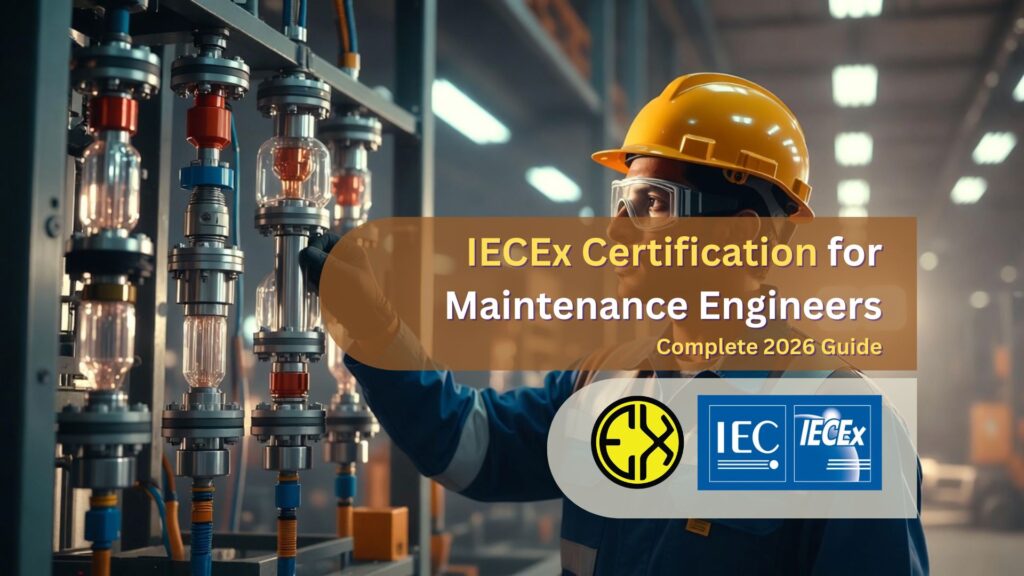
Maintenance and inspection engineers working in hazardous environments face unique challenges that require specialized skills and global safety standards. IECEx Certification empowers engineers and employers alike with recognized competence essential for compliance, safety, and career advancement. This article explores what IECEx Certification is, how it works, and why it’s so valuable for professionals operating in explosive atmospheres.
Whether you’re a new engineer or an industry veteran, discover how to achieve and leverage IECEx Certification for safer workplaces and professional growth in the UAE, Saudi Arabia, and beyond.
IECEx Certification: The Gold Standard for Safe Maintenance and Inspection
IECEx Certification is widely regarded as the international benchmark for competence in hazardous area operations. It validates the knowledge and skills necessary to safely maintain, inspect, and manage equipment in explosive atmospheres, delivering confidence to both employees and employers. Engineers earn this certification through industry-standard training that aligns with global expectations and GCC regulatory requirements.
What Is IECEx Certification?
IECEx Certification is a globally recognized system based on IEC international standards, specifically aimed at ensuring safety in explosive atmospheres found in oil and gas, petrochemicals, and other high-risk sectors. Unlike product or equipment certification, IECEx certifies personnel competence, guaranteeing that certified engineers adhere to best safety practices.
This standardization opens international doors for engineers, providing credentials accepted across 35+ member countries. For maintenance professionals working with explosion-proof equipment, junction boxes, motors, and instrumentation in classified zones, IECEx Certificate of Personnel Competence (CoPC) demonstrates verified expertise that employers and contractors demand.
How IECEx Certification Works: Step-by-Step
Understanding the certification process is crucial before you embark on the journey. Here’s how it works:

Training Enrollment: Choose an accredited program tailored to your industry and experience level. Maintenance engineers typically pursue Units Ex 002 (Installation) and Ex 003 (Maintenance and Repair) which directly address their daily responsibilities.
Theoretical Learning: Complete core modules that cover hazard identification, zone classification, protection techniques (Ex d, Ex e, Ex i), equipment selection, and inspection procedures. These modules build foundational knowledge essential for safe work in explosive atmospheres.
Practical Assessment: Demonstrate skills through real-world scenarios and hands-on testing. This includes cable gland installation verification, flameproof joint inspection, earthing continuity testing, and equipment condition assessment under simulated field conditions.
Certification Awarded: Upon successful assessment, receive your IECEx CoPC certification valid internationally. This credential proves you understand not just what to do, but why specific procedures matter for explosion protection.
Recertification: Maintain your competence with renewal every five years, ensuring up-to-date best practices. This renewal requirement keeps certified professionals current with evolving standards and emerging technologies in hazardous area equipment.
How to Get IECEx Certified — Quick Steps
Getting certified follows a straightforward path when you work with accredited training providers:
Visit an IECEx certification training page and review available programs. Select the relevant training module that fits your role and goals—maintenance engineers should focus on Units 2 and 3 for practical field competence.
Sign up and participate in the mix of online and onsite sessions. The blended learning approach accommodates working professionals who can’t take extended time away from job sites.
Complete your written and practical exams with the support of expert trainers who understand real-world maintenance challenges. Practical assessments verify you can actually perform critical tasks, not just memorize theory.
Receive and proudly display your globally acknowledged IECEx certificate. This credential immediately distinguishes you from non-certified peers in job applications, tender qualifications, and project assignments.
Key Benefits for Engineers and Employers
Universal Recognition
IECEx Certification is accepted worldwide, enabling trained engineers to engage in international assignments seamlessly. This recognition ensures that qualifications meet global safety standards, making job transitions and project involvement smoother across borders.
For maintenance engineers, this means streamlined access to international projects and contracts without redundant certification processes. A single IECEx CoPC opens opportunities from Abu Dhabi to Brisbane to Houston—anywhere explosive atmospheres require certified competence.
Operational Efficiency
Certified engineers prevent costly compliance failures by ensuring adherence to the latest hazardous area standards. Training equips engineers to efficiently identify risks and maintain equipment properly, leading to fewer unplanned stoppages and reduced maintenance overheads.
Enhanced productivity flows from improved inspection and maintenance routines. When your team understands protection principles deeply, they work faster without compromising safety. Reduced downtime results from proactive risk management—catching problems before they cause production losses.
Risk Management
Organizations with IECEx-certified professionals often benefit from better audits and insurance premiums. Regulators and insurers trust facilities staffed by certified teams to have robust safety procedures, which minimizes accident risks and liability exposures.
Favorable insurance terms and easier regulatory approvals translate directly to operational cost savings. Lower operation costs link to fewer safety incidents—certified maintenance teams simply make fewer mistakes that could trigger explosions or fires.
Career Progression
Certification boosts engineers’ skills and positions them for leadership roles in maintenance and safety management. Certified personnel are highly sought after for their expertise and dedication to safety excellence, providing a competitive advantage in the GCC job market.
Improved prospects for supervisory and specialist roles come naturally. Employers promoting maintenance supervisors or facility engineers prioritize candidates with verified competence. Greater visibility and credibility in international job markets opens doors that remain closed to non-certified competitors.
Salary increases of 30-50% are common after certification, reflecting the market value of proven hazardous area expertise. For maintenance engineers in UAE and KSA, IECEx CoPC often determines whether you earn AED 15,000 or AED 22,000 monthly for similar work.
Best Practices: Pass the IECEx Assessment on Your First Attempt
Passing the IECEx assessment requires preparation and strategy. Follow these proven approaches:
Thoroughly review training materials and core IECEx modules before exam day. Don’t rely solely on classroom time—dedicate personal study hours to absorb complex concepts like intrinsic safety calculations or temperature class determination.
Participate actively in practical workshops. The hands-on skills tested in assessments can’t be learned from books alone. Practice cable gland installation, flameproof joint measurement, and continuity testing until procedures become automatic.
Take mock exams to assess readiness. Many candidates fail first attempts because they overestimate their preparation. Practice tests reveal knowledge gaps while there’s still time to address them.
Seek guidance from experienced instructors to address weaknesses. Don’t wait until after failing an exam to ask questions. Instructors want you to succeed—use their expertise during training, not after disappointment.
These practices help maximize your chance of success on the first try, saving both time and the expense of retaking assessments.
Case Study: IECEx Certification in Action
A refinery in Abu Dhabi enhanced operational safety by enrolling their maintenance team for IECEx certification. Post-training, hazard identification improved by 35% as technicians better recognized when equipment modifications compromised explosion protection.
Workplace incidents decreased by 25% within a year following certification. The maintenance team’s deeper understanding of protection principles prevented several near-miss events that previously went unrecognized until equipment failed.
The certification also elevated insurer confidence, positively impacting premiums. The facility’s annual insurance costs dropped by 18% when underwriters verified the certified maintenance competence across the team.
Most significantly, maintenance supervisor reported that certified technicians completed tasks faster because they understood why procedures mattered, reducing questioning and hesitation during critical work.
Understanding IECEx vs Other Certifications
Maintenance engineers often encounter multiple certification options and need clarity on which matters most for their careers. IECEx differs from CompEx primarily in global recognition scope—IECEx provides broader international acceptance while CompEx maintains stronger presence in UK and Commonwealth markets.
For engineers working in UAE, Saudi Arabia, Qatar, and other GCC countries, IECEx alignment with regional regulatory frameworks makes it the strategically superior choice. Major operators like ARAMCO, ADNOC, and SABIC increasingly specify IECEx CoPC in their contractor pre-qualification requirements.
ATEX certification, while mandatory for European equipment sales, doesn’t certify personnel competence. Maintenance engineers need personnel certification like IECEx CoPC, not equipment certification like ATEX, to verify their own skills rather than product compliance.
Key Takeaway Checklist
- Ensure you enroll with an accredited IECEx training provider recognized by the IECEx system
- Follow the structured training and assessment process diligently without shortcuts
- Utilize practice exams and instructor feedback frequently during preparation
- Plan for recertification every five years to maintain credential validity
- Document your certified competence prominently on CVs and professional profiles
- Continue learning beyond certification—standards evolve and best practices improve
Summary & Action Steps
IECEx Certification is critical for safety, operational success, and professional growth in hazardous area environments. The GCC region benefits from flexible, expert-led programs that prepare maintenance and inspection engineers comprehensively for this global credential.
Take the next step today: research IECEx certification requirements for new engineers and enroll in upcoming courses to secure your future in the explosive atmosphere industry. Your career advancement and earning potential depend significantly on verified competence that only proper certification provides.
Don’t delay—facilities across UAE and Saudi Arabia actively seek certified maintenance professionals right now. The gap between supply and demand for IECEx-certified engineers creates exceptional opportunities for those who invest in proper training.
Glossary: Essential IECEx Terms for Maintenance Engineers
1. Explosive Atmosphere
A mixture of air and flammable gases, vapors, mists, or combustible dusts under atmospheric conditions where, after ignition, combustion spreads throughout the unconsumed mixture. Example: Natural gas leaking into a confined space creates an explosive atmosphere in the flammable concentration range.
2. Zone Classification
System for categorizing hazardous areas based on the probability and duration of explosive atmosphere presence. Zones 0, 1, 2 apply to gases/vapors; Zones 20, 21, 22 to combustible dusts. Example: Inside a storage tank containing volatile liquids is classified Zone 0 because explosive atmosphere is continuously present.
3. Ex d (Flameproof Enclosure)
Protection method where equipment is enclosed in a housing that can withstand internal explosion and prevent flame transmission to external atmosphere. Example: A motor junction box with precisely machined flame paths that cool escaping gases below ignition temperature.
4. Ex e (Increased Safety)
Protection method preventing ignition sources through enhanced construction and additional safety margins—no sparking parts, controlled temperatures, increased creepage distances. Example: A terminal box with extra spacing between live parts and no switching contacts that could spark.
5. Ex i (Intrinsic Safety)
Protection method limiting electrical energy in circuits so that neither sparks nor thermal effects can cause ignition, even under fault conditions. Example: A 4-20mA temperature sensor drawing so little power that short circuits or component failures cannot generate ignition-capable energy.
6. Temperature Class (T-Class)
Maximum surface temperature equipment can reach during operation, classified T1-T6. Must be lower than ignition temperature of gases present. Example: Equipment marked T4 (135°C max) is safe for locations with hydrogen (ignition 560°C) but not for carbon disulfide (ignition 90°C).
7. Gas Group
Classification of flammable gases based on their ignition characteristics and explosion properties—Groups IIA, IIB, IIC. Example: Hydrogen belongs to Group IIC (most easily ignited), requiring equipment with tighter flame path tolerances than Group IIA propane.
8. Equipment Protection Level (EPL)
System indicating required protection level: Ga/Da (Zone 0/20), Gb/Db (Zone 1/21), Gc/Dc (Zone 2/22). Example: EPL Gb equipment provides protection suitable for Zone 1 areas where explosive atmospheres occur occasionally during normal operation.
9. Certificate of Conformity (CoC)
Document issued by ExCB confirming equipment meets IECEx standards. Separate from personnel CoPC certification. Example: A certified explosion-proof lighting fixture carries a CoC from an accredited certification body listing its protection type, zone suitability, and technical specifications.
10. Competent Person
Individual with training, knowledge, and practical experience to perform assigned work safely in hazardous areas. IECEx CoPC provides objective verification of competence. Example: A maintenance technician with Unit Ex 003 certification who understands when gasket replacement in flameproof enclosures requires engineering review before equipment re-energization.
Frequently Asked Questions (FAQs)
Typically, five years with renewal or recertification recommended. The renewal process requires evidence of continuing professional development and maintained work experience in hazardous area environments.
No, IECEx CoPC focuses on certifying personnel competence, not products. Equipment carries its own certification (IECEx CoC), but personnel certification verifies that you understand how to work safely with that certified equipment.
No, IECEx CoPC focuses on certifying personnel competence, not products. Equipment carries its own certification (IECEx CoC), but personnel certification verifies that you understand how to work safely with that certified equipment.
Yes, a blend of online and onsite training is offered for convenience and flexibility. However, practical assessments must be completed in-person as they require hands-on demonstration of field skills.
You can no longer legally work in certified hazardous areas in many jurisdictions. You’ll need to retake the training and examination to regain certification status. Don’t let expiration occur—plan renewal 6-12 months before expiry.
Most providers recommend 2-3 years of relevant industry experience. However, entry-level engineers can obtain Unit 1 certification with proper training and education, then progress to Units 2-3 as experience accumulates.
Maintenance engineers should pursue Units Ex 002 and Ex 003. Unit Ex 001 is beneficial for design engineers. Choose based on your specific job responsibilities—installation, maintenance, or design work.
Yes, IECEx recognition spans 35+ member countries. Your certification validates competence globally, though specific project requirements may vary. Always verify client-specific credential expectations before accepting international assignments.
Costs vary by provider and unit level, typically ranging from AED 5,000 to AED 15,000 for complete training and examination. Consider this an investment—the salary increase following certification usually recovers costs within 3-6 months.
First-attempt pass rates average 60-70% for well-prepared candidates. Failure often results from inadequate study time or skipping practical workshop attendance. Follow recommended preparation practices to maximize success probability.
Many employers cover certification costs for maintenance staff as professional development investment. If your employer won’t pay, self-funding remains worthwhile given career advancement and salary increase potential.